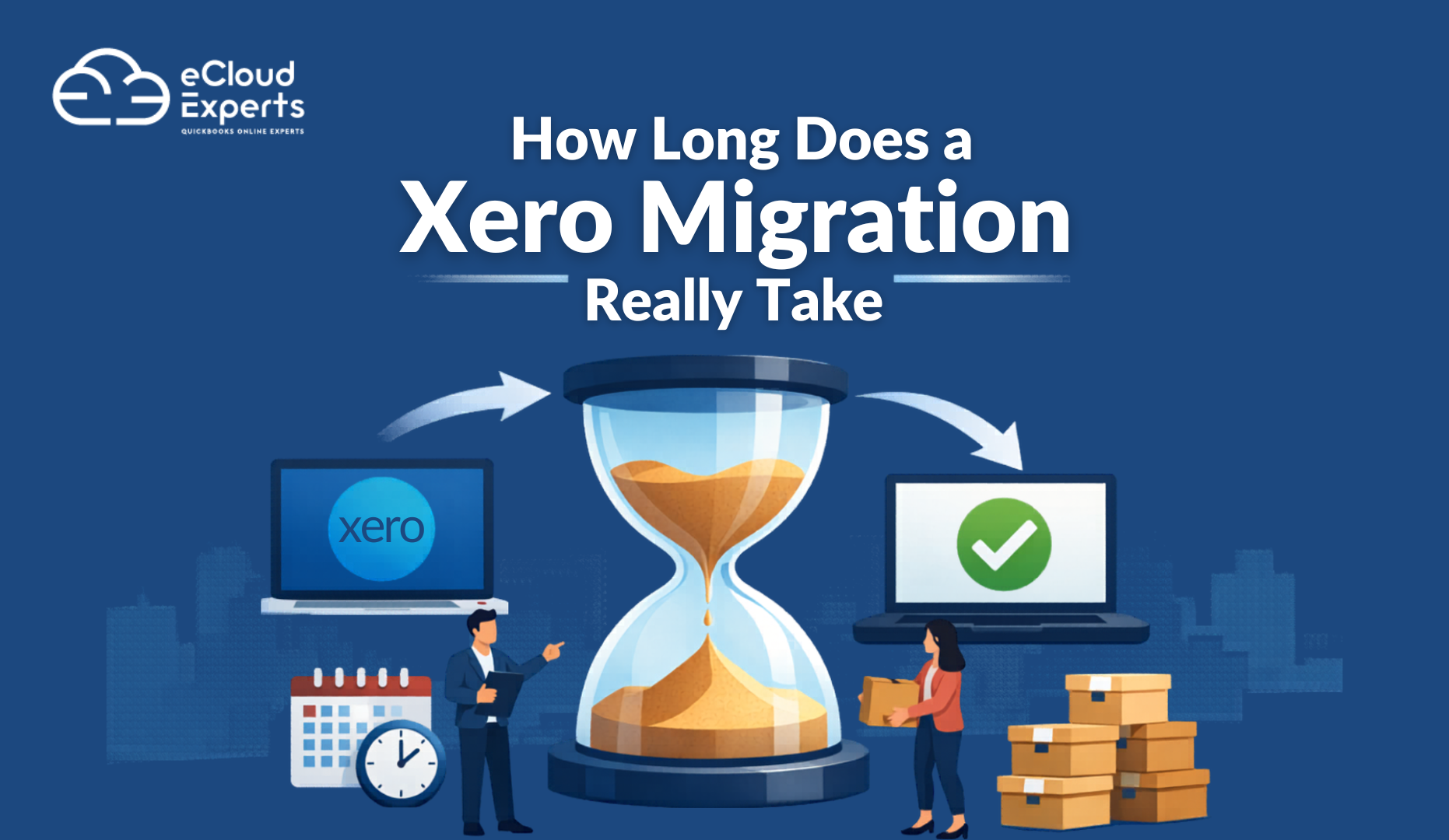
You are probably asking one simple question. How long does a Xero migration take
And the honest answer is this. It depends. But not in a vague or confusing way.
Some businesses move in just a few days. Others take a couple of weeks. In more complex cases, it can take close to a month. The difference comes down to a few key things. Your data quality, your current setup, and how prepared you are before the migration begins.
Here is where most people get it wrong.
They think migration is just a quick data upload. But a proper move to Xero involves planning, checking, and validation. If done badly, it creates errors that take longer to fix later.
That is why understanding the real timeline matters.
This guide gives you a clear breakdown of the Xero migration timeline, what affects it, and how to avoid delays.
How Long Does a Xero Migration Take on Average
Most businesses fall into a simple timeline range. But the exact timing depends on how clean and organised your data is before the process begins.
Here is a realistic breakdown:
- Small businesses with clean data: 2 to 5 days
- Growing businesses with moderate data: 1 to 2 weeks
- Complex businesses or large data sets: 2 to 4 weeks
These timelines are based on real migration projects, not guesswork.
But here is the key point.
Your time to migrate to Xero is not just about business size. It is about data quality.
If your books are clean, structured, and up to date, the migration moves quickly with fewer checks needed.
On the other hand, if your records are messy, incomplete, or inconsistent, the process slows down. Extra time is needed to fix errors, balance accounts, and make sure everything matches correctly after migration.
So while the timeline may look simple on paper, the real speed depends on how prepared your data is before you start.
What Actually Happens During a Xero Migration
Many people think it is just a simple transfer. Upload your data and start using Xero. But in reality, a proper Xero data migration process follows a structured approach to protect your financial accuracy.
It is not just about moving data. It is about making sure everything is correct, complete, and ready for real use.
Here is what actually happens behind the scenes:
- Review your current accounting system
- Clean and prepare your data
- Transfer data into Xero
- Check and validate all reports
- Final setup and go live
Let’s break this down a bit further.
First, your existing system is reviewed. This helps identify what data needs to be moved and what can be left behind. It also highlights any issues early.
Next comes data preparation. This is where most of the real work happens. Errors are fixed, duplicates are removed, and missing information is completed. Clean data is the foundation of a successful migration.
Then the actual transfer takes place. Your financial data is moved into Xero in a structured format so it fits correctly within the system.
After that, everything is checked. Reports like your balance sheet and profit and loss are compared with your old system to make sure nothing is missing or incorrect.
Finally, the system is set up for daily use. This includes bank feeds, user access, and any tools your business relies on.
Each of these steps plays a critical role.
Skip or rush even one step, and you risk ending up with incorrect numbers, broken reports, or missing transactions. Fixing those issues later takes more time and effort than doing it right from the start.
Xero Migration Timeline Breakdown Step by Step
Now let’s break down exactly how long to switch to Xero.
Step 1 Review and Planning
Time: 1 to 2 days
This stage sets the foundation.
You review your current system and decide:
- How much data to move
- Which reports must match
- What your new setup should look like
Good planning reduces delays later.
Step 2 Data Preparation
Time: 2 to 5 days
This is often the most time consuming part.
Your data is cleaned and corrected.
Common issues include:
- Duplicate transactions
- Missing records
- Incorrect balances
The cleaner your data, the shorter your Xero migration duration.
Step 3 Data Migration
Time: 1 to 3 days
This is where the actual transfer happens.
Data moved includes:
- Contacts
- Chart of accounts
- Invoices and bills
- Bank transactions
If everything is prepared well, this step is fast.
Step 4 Testing and Validation
Time: 1 to 3 days
This step checks accuracy.
Reports in Xero are compared with your old system:
- Trial balance
- Profit and loss
- Balance sheet
If something does not match, it is fixed here.
Step 5 Final Setup and Go Live
Time: 1 to 2 days
Now everything is ready.
Final setup includes:
- Bank feeds
- User access
- Invoice templates
- Integrations
At this point, your business starts using Xero fully.
What Affects How Long a Xero Migration Takes
Still wondering how long does a Xero migration take for your business
Here are the real factors.
Data Volume
More transactions mean more work.
A business with years of data will take longer than one with a few months.
Data Quality
Clean data speeds things up.
Messy data slows everything down.
Number of Years Migrated
Moving one year is quick.
Moving multiple years takes more time and checking.
Business Complexity
If your business uses:
- Multiple currencies
- Inventory systems
- Advanced reporting
Then your Xero migration timeline increases.
Integrations
Connecting tools like ecommerce platforms or CRM systems adds extra steps.
Industry Requirements
Some industries need detailed reporting and compliance checks. This adds time but improves accuracy.
QuickBooks Sage or Excel to Xero How Timelines Compare
Your starting system plays a big role.
QuickBooks to Xero
- Usually 1 to 2 weeks
- Structured data makes it smoother
Sage to Xero
- 1 to 3 weeks
- Can be more complex depending on setup
Excel to Xero
- 3 days to 1 week
- Depends on how well data is organised
So when asking how long a Xero migration takes, your current system matters.
Fast vs Slow Xero Migration What Causes Delays
Let’s be direct. Most delays are avoidable.
Here are the common reasons:
- Messy or incomplete data
- Missing financial records
- Poor planning
- Last minute changes
- Trying to rush the process
A rushed migration often leads to errors. Fixing those errors takes more time later.
How to Speed Up Your Xero Migration
If you want a faster time to migrate to Xero, focus on preparation.
- Clean your books before starting
- Decide what data you actually need
- Avoid moving unnecessary history
- Prepare key reports in advance
- Work with experienced migration experts
Speed comes from clarity and preparation.
Real Example Xero Migration Timeline
Let’s look at a real scenario.
Problem
A retail business had two years of messy QuickBooks data.
Action
Data was cleaned first, then migrated with proper checks.
Result
- Total migration time: 10 days
- Clean and accurate reports
- No issues after going live
This shows that even complex cases can be handled efficiently with the right approach.
Is a Fast Xero Migration Always Better
Not always.
A fast migration might sound appealing, especially if you want to switch systems quickly. But speed comes with risk if it is not handled carefully.
When a migration is rushed, important checks are often skipped. This can lead to issues like incorrect balances, missing transactions, or reports that do not match your previous system.
These problems do not always show up immediately. But when they do, they affect your reporting, tax calculations, and business decisions.
Fixing these errors later takes more time, more effort, and sometimes more cost than doing the migration properly in the first place.
That is why accuracy should always come before speed.
Taking a few extra days to review, validate, and confirm everything is correct gives you confidence in your numbers from day one.
In simple terms, a slightly slower migration done right is always better than a fast one done wrong.
Final Thoughts How Long Should You Expect
So, how long does a Xero migration take
Here is the simple and honest answer.
- Basic setup: a few days
- Standard business: 1 to 2 weeks
- Complex migration: up to 4 weeks
These timelines give you a realistic expectation. But remember, no two businesses are the same.
Your timeline depends on three key things:
- The quality of your data
- The complexity of your current system
- How well you prepare before the migration starts
If your books are clean and your plan is clear, the process moves quickly and smoothly.
If not, delays are almost guaranteed.
That is why preparation matters more than speed.
Take the time to do it right, and your Xero setup will be accurate, reliable, and ready to support your business from day one.
Plan properly, and the entire process becomes predictable instead of stressful.
Ready to Start Your Xero Migration
If you want your migration done correctly without delays or costly errors, expert support makes a real difference.
Many businesses struggle not because migration is difficult, but because it is done without proper planning or checks. That is where having the right team changes everything.
At eCloud Experts, we manage the entire process for you from start to finish.
- We review and clean your data before migration
- We ensure every number matches accurately
- We handle the full setup so your system is ready to use
- We support you even after you go live
The result is simple. Clean books, reliable reports, and a system you can trust from day one.
Do not risk errors that could affect your business decisions later.
Get in touch today and start your Xero migration with complete confidence