Running a business today is very different from how it was ten years ago. Companies need real time financial information, remote access, faster reporting, and systems that support growth without creating unnecessary complexity.
For many small and mid sized businesses, traditional ERP systems once seemed like the obvious choice. They offered extensive functionality and enterprise level features. However, as technology has evolved, many businesses have started questioning whether they truly need large, expensive ERP platforms.
As a result, more organizations are deciding to move from ERP to Xero. They are discovering that cloud accounting software can provide the tools they need without the high costs, long implementation times, and complicated processes associated with traditional ERP systems.
In this guide, we will explore why businesses are making the decision to move from ERP to Xero, what benefits they gain, and how a successful migration can support future growth.
Understanding Traditional ERP Systems
Enterprise Resource Planning systems, commonly known as ERP systems, are designed to manage multiple business functions within a single platform.
These systems often include:
- Financial management
- Inventory control
- Purchasing
- Manufacturing
- Project management
- Human resources
- Reporting and analytics
Popular ERP platforms include:
- NetSuite
- SAP Business One
- Microsoft Dynamics
- Sage X3
- Acumatica
- Oracle ERP
While these systems offer powerful functionality, they can also become expensive and difficult to manage, especially for growing small and mid sized businesses.
Why Businesses Decide to Move from ERP to Xero
Many business owners initially invest in ERP software because they expect it to support future growth.
However, after several years, they often discover that:
- The system is too complex for their daily needs
- Users only utilize a small percentage of available features
- Software costs continue to increase
- Reporting is difficult to customize
- Staff require ongoing training
- Upgrades are expensive
- Remote access is limited
This is where the decision to move from ERP to Xero begins to make sense.
Rather than paying for features they rarely use, businesses can focus on a simpler, cloud based solution that delivers what they actually need.
Lower Software Costs
One of the biggest reasons companies choose to move from ERP to Xero is cost reduction.
Traditional ERP systems often involve:
- High licensing fees
- Annual maintenance contracts
- Upgrade costs
- Server expenses
- IT support costs
- Consultant fees
These expenses can quickly add up.
Xero operates on a subscription model that offers predictable monthly pricing. Businesses know exactly what they are paying each month without worrying about large upgrade bills or infrastructure costs.
For many companies, the savings achieved after they move from ERP to Xero can be substantial.
Easier to Use
Many ERP systems were designed for large organizations with dedicated finance departments.
As a result, they often include:
- Complex menus
- Multiple modules
- Lengthy workflows
- Advanced configuration requirements
For smaller businesses, this complexity can create frustration.
Xero focuses on simplicity.
Its clean interface allows users to:
- Create invoices
- Reconcile bank transactions
- Run reports
- Manage bills
- Monitor cash flow
without extensive training.
This ease of use is a major reason businesses continue to move from ERP to Xero.
Faster Access to Financial Information
Business owners need accurate financial information quickly.
Traditional ERP systems can sometimes require:
- Complex report setup
- Manual data extraction
- Custom reporting tools
- External consultants
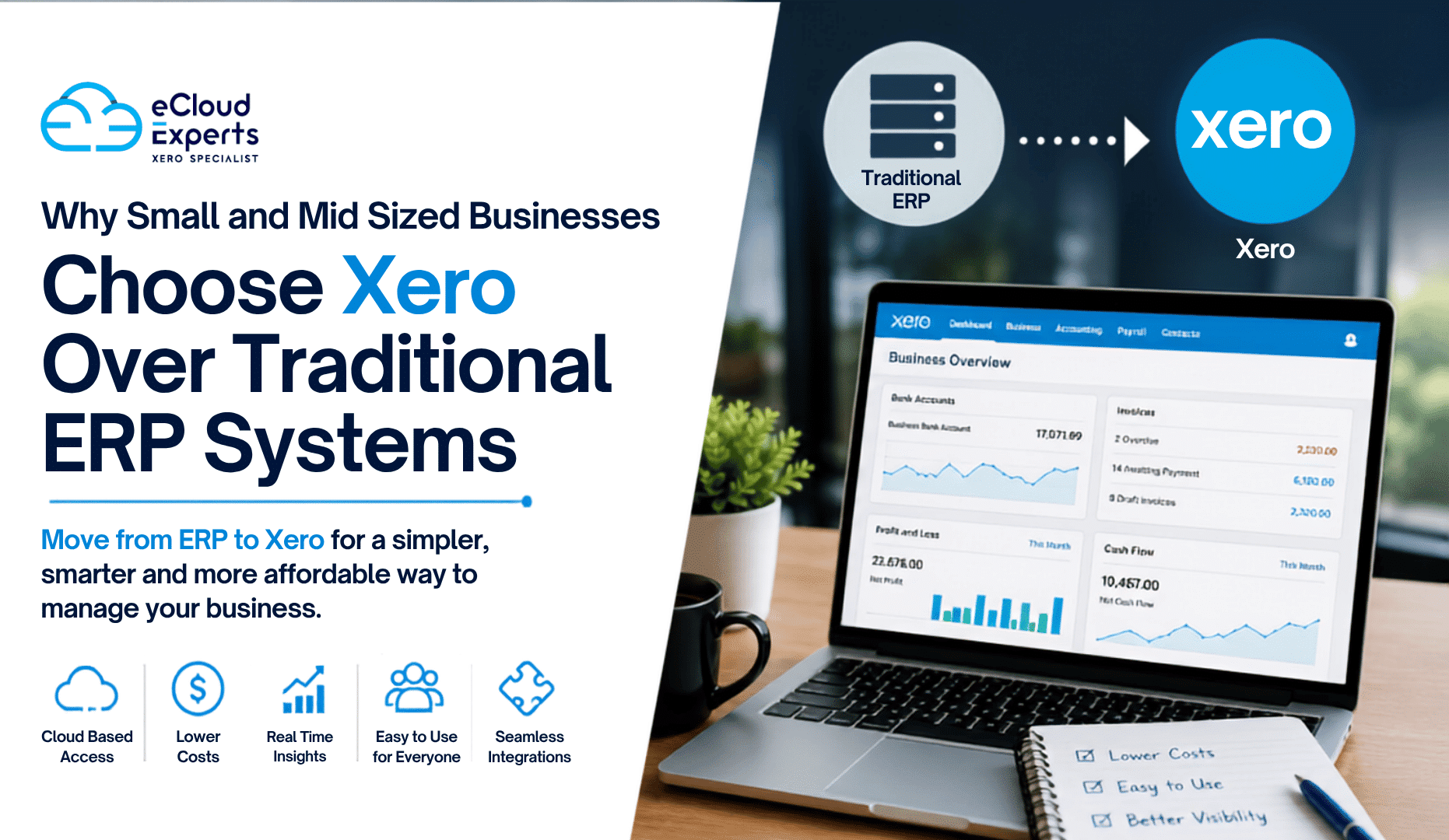
Xero provides real time dashboards that display:
- Bank balances
- Outstanding invoices
- Bills due
- Cash flow information
- Financial performance
This immediate visibility helps management make faster decisions.
Companies that move from ERP to Xero often report significant improvements in financial transparency.
Cloud Based Accessibility
The modern workforce is increasingly mobile.
Employees work from:
- Home offices
- Client locations
- Different branches
- International locations
Traditional ERP systems may require:
- VPN access
- Dedicated servers
- Remote desktop software
Xero is fully cloud based.
Users can securely access financial data from virtually anywhere with an internet connection.
This flexibility is another reason organizations choose to move from ERP to Xero.
Reduced IT Requirements
Maintaining ERP infrastructure can become a significant burden.
Businesses may need:
- Internal IT teams
- Server maintenance
- Security updates
- Backup systems
- Disaster recovery plans
With Xero, these responsibilities are greatly reduced.
The platform handles:
- Security updates
- System maintenance
- Data backups
- Software enhancements
As a result, companies that move from ERP to Xero often reduce both IT costs and administrative workload.
Faster Implementation
ERP implementations can take months or even years.
Common challenges include:
- Data cleansing
- System configuration
- Staff training
- Custom development
- Testing cycles
In contrast, Xero deployments are generally much faster.
After businesses move from ERP to Xero, they can often begin using the platform within weeks rather than months.
This faster implementation allows organizations to focus on running their business rather than managing software projects.
Better Integration with Modern Business Apps
Today’s businesses rely on specialized software for different functions.
Examples include:
- CRM systems
- Ecommerce platforms
- Payroll solutions
- Inventory tools
- Payment gateways
Xero integrates with hundreds of business applications.
Popular integrations include:
- Shopify
- WooCommerce
- HubSpot
- Stripe
- PayPal
- Dext
- ApprovalMax
Businesses that move from ERP to Xero often discover that these integrations improve efficiency and reduce manual work.
Improved Collaboration with Accountants
Accountants and bookkeepers increasingly prefer cloud based systems.
Traditional ERP environments can create challenges when external advisors need access.
With Xero:
- Advisors can access data securely
- Reports are available instantly
- Collaboration happens in real time
- Questions can be resolved quickly
This improved collaboration is another factor encouraging businesses to move from ERP to Xero.
Scalability Without Complexity
Many organizations worry that moving away from ERP systems may limit growth.
In reality, Xero supports thousands of growing businesses worldwide.
As businesses expand, they can add:
- Additional users
- Inventory applications
- Reporting tools
- Industry specific integrations
This allows companies to scale without maintaining an overly complex ERP environment.
That is why many growing organizations continue to move from ERP to Xero even as revenue increases.
Better User Adoption
A software system only delivers value if employees actually use it.
ERP platforms often suffer from:
- Low user adoption
- Training challenges
- Resistance to change
Xero’s intuitive design helps employees become productive more quickly.
Higher adoption rates mean businesses gain greater value from their accounting software investment.
This is another practical reason businesses decide to move from ERP to Xero.
Common ERP Systems Businesses Replace with Xero
Organizations frequently migrate from:
NetSuite to Xero
Companies seeking lower costs and simpler accounting workflows often move away from NetSuite.
Sage ERP to Xero
Many businesses want a modern cloud platform with easier access and reporting.
Microsoft Dynamics to Xero
Smaller organizations sometimes find Dynamics more complex than necessary for their needs.
Acumatica to Xero
Businesses looking to simplify operations often choose Xero as a more user friendly alternative.
SAP Business One to Xero
Growing companies may decide that SAP’s extensive functionality exceeds their current requirements.
Key Considerations Before You Move from ERP to Xero
Before starting a migration project, businesses should evaluate:
Historical Data Requirements
Determine how many years of data need to be migrated.
Chart of Accounts Structure
Review account codes and reporting requirements.
Customer and Supplier Records
Ensure contact information is clean and accurate.
Open Transactions
Identify outstanding invoices, bills, and balances.
Reporting Needs
Confirm that required reports can be recreated within Xero.
Integration Requirements
Review all connected applications before migration.
Proper planning helps ensure a successful transition.
How eCloud Experts Helps Businesses Move from ERP to Xero
At eCloud Experts, we help businesses safely move from ERP to Xero with minimal disruption.
Our migration specialists manage:
- Data assessment
- Historical data migration
- Customer and supplier imports
- Opening balances
- Financial validation
- Xero setup and configuration
- User training
- Post migration support
We work with businesses migrating from a wide range of ERP platforms and ensure data accuracy throughout the process.
The Future Is Cloud Accounting
Technology continues to evolve rapidly.
Businesses increasingly want:
- Real time information
- Lower operating costs
- Greater flexibility
- Faster reporting
- Easier collaboration
Traditional ERP systems still serve many large enterprises well. However, for small and mid sized businesses, the benefits of cloud accounting are becoming difficult to ignore.
That is why more organizations continue to move from ERP to Xero as they seek a simpler, more cost effective way to manage their finances.
Conclusion
Choosing the right accounting system is one of the most important decisions a growing business can make.
While ERP systems offer extensive functionality, many small and mid sized businesses discover they no longer need the complexity, expense, and maintenance that come with enterprise software.
By choosing to move from ERP to Xero, businesses can reduce costs, improve accessibility, simplify processes, and gain better visibility into their financial performance.
As cloud technology continues to advance, Xero remains a strong choice for businesses looking for flexibility, efficiency, and long term growth.
Frequently Asked Questions
Why do businesses move from ERP to Xero?
Businesses often move because they want lower costs, easier usability, cloud accessibility, and faster financial reporting.
Is Xero suitable for growing businesses?
Yes. Xero supports growing businesses through its cloud platform and extensive integration ecosystem.
How long does it take to move from ERP to Xero?
Migration timelines vary depending on data complexity, but many projects can be completed within a few weeks.
Can historical ERP data be migrated to Xero?
Yes. Customer records, supplier information, invoices, balances, and historical transactions can often be migrated depending on project requirements.
Which ERP systems can be migrated to Xero?
Common migrations include NetSuite, Sage ERP, Microsoft Dynamics, Acumatica, SAP Business One, and other ERP platforms.
Do I need professional help to move from ERP to Xero?
Professional migration support helps ensure data accuracy, minimizes business disruption, and reduces the risk of migration errors.
Ready to Move from ERP to Xero? Let eCloud Experts Handle the Migration
If your current ERP system feels expensive, complicated, or no longer fits the way your business operates, now may be the perfect time to make a change. Many small and mid sized businesses are discovering that Xero provides the flexibility, visibility, and ease of use they need without the high costs and complexity of traditional ERP software.
At eCloud Experts, we specialize in helping businesses move from ERP to Xero safely and accurately. Our experienced migration team manages every stage of the process, from reviewing your existing data and preparing records to importing financial information, validating balances, and setting up your new Xero environment.
Whether you are migrating from NetSuite, Sage ERP, Microsoft Dynamics, Acumatica, SAP Business One, or another ERP platform, we ensure your transition is carefully planned and professionally executed.
When you work with eCloud Experts, you benefit from:
- Accurate data migration
- Minimal business disruption
- Secure handling of financial information
- Expert Xero setup and configuration
- User training and ongoing support
- Post migration validation and assistance
Do not let an outdated or overly complex ERP system hold your business back. Take the next step toward simpler accounting, better reporting, and greater flexibility.
Contact eCloud Experts today for a free consultation and discover how easy it can be to move from ERP to Xero with confidence.