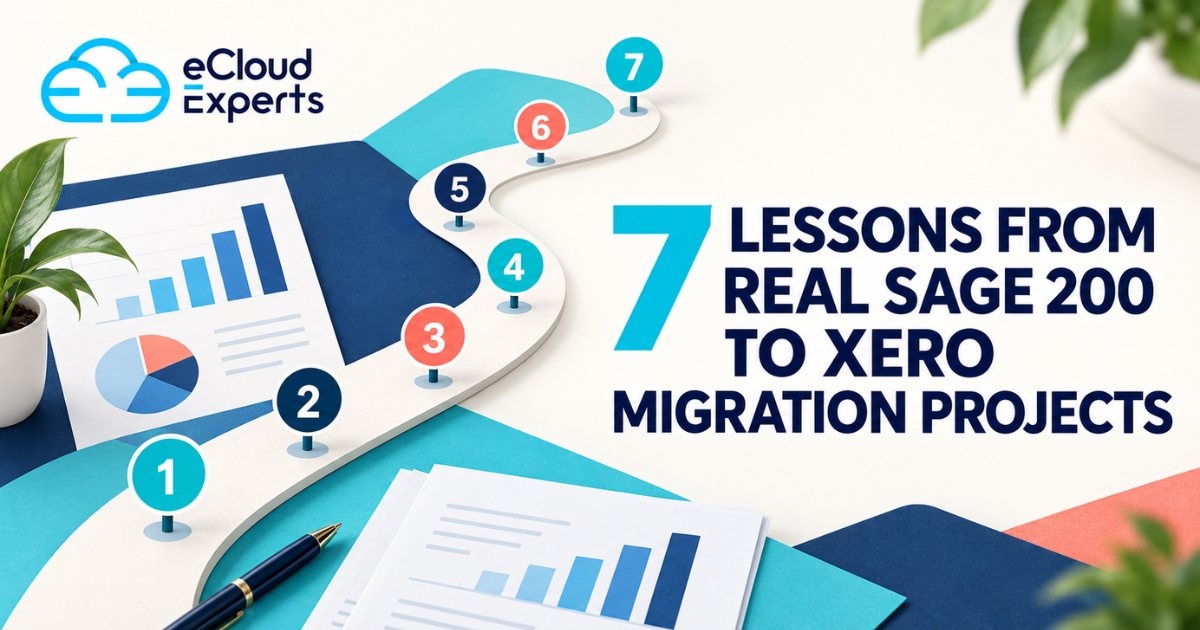
Moving from Sage 200 to Xero can simplify daily accounting. It can also improve access, reporting, and collaboration.
However, migration involves more than transferring figures. Sage 200 and Xero organise financial data differently. Some records can move directly. Others need mapping, restructuring, or a new working process.
These seven Sage 200 migration lessons explain what businesses should check before starting. They cover planning, data preparation, testing, reconciliation, training, and ongoing support.
Why Sage 200 Migrations Need Careful Planning
Sage 200 often supports detailed finance operations. A business may have several companies, departments, currencies, warehouses, and connected systems.
Xero offers a simpler cloud accounting platform. However, it does not reproduce every Sage 200 feature in the same way.
Planning helps the migration team answer important questions:
- What information must move?
- How much history is required?
- Which reports must remain available?
- How will departments be managed?
- Are connected applications still suitable?
- Does the business need inventory software?
- When should the business start using Xero?
A rushed migration can cause missing records, incorrect balances, and confused users. A planned migration creates a clearer and safer route into Xero.
Lesson 1: Define the Migration Scope Before Extracting Data
The first lesson is simple. Decide exactly what needs to move before extracting any records.
Some businesses only require opening balances and unpaid invoices. Others need several years of detailed transactions.
The migration scope should confirm:
- The required migration period
- The proposed Xero go live date
- The number of Sage 200 companies
- The currencies used
- The required tracking categories
- Monthly sales invoice volumes
- Monthly purchase invoice volumes
- Monthly bank transaction volumes
- Stock and inventory requirements
- Connected applications
- Required management reports
- Training and support needs
Moving unnecessary history can increase cost and complexity. Moving too little can reduce reporting value.
The correct scope depends on business needs. It should never be based on assumptions.
Opening Balances or Full History?
This is one of the first decisions to make.
An opening balance migration brings the financial position into Xero from an agreed date. It normally includes the trial balance, outstanding invoices, outstanding bills, and bank balances.
A full historical migration brings detailed transactions into Xero. This may include invoices, bills, payments, journals, and bank transactions.
Full history offers stronger comparison and reporting. However, it also requires more preparation and testing.
Businesses should consider:
- Legal record requirements
- Management reporting needs
- Audit requirements
- Available Sage 200 data
- Data quality
- Project budget
- Required completion date
The best option is the one that supports future work without adding unnecessary complexity.
Lesson 2: Clean Sage 200 Data Before Migration
Poor source data does not improve when moved into Xero. It simply becomes poor data in a new system.
Before migration, review Sage 200 for common issues.
These may include:
- Duplicate customer records
- Duplicate supplier records
- Unused nominal accounts
- Unallocated payments
- Incorrect tax codes
- Unreconciled bank transactions
- Suspense account balances
- Old unpaid invoices
- Unapplied credit notes
- Incomplete contact details
- Incorrect opening balances
- Transactions posted to the wrong period
Cleaning the source data reduces mapping errors. It also prevents unnecessary records from entering Xero.
Not every historical issue needs correction. Some old records may remain in Sage 200 for reference. The migration scope should clearly state what will be cleaned, transferred, or archived.
Why Data Quality Affects the Project Cost
Migration cost is not only based on the number of years.
A single year of poor data may require more work than five years of clean data. The migration team may need to investigate balances, correct records, or rebuild missing links.
The following issues can increase the work required:
- Missing source reports
- Unbalanced ledgers
- Large suspense balances
- Duplicate transactions
- Incorrect customer allocations
- Incomplete foreign currency records
- Inconsistent account coding
- Previous migration errors
A data review before quoting can produce a more reliable project price.
Lesson 3: Account Mapping Needs Human Review
Sage 200 and Xero use different account structures. Account names alone are not enough for accurate mapping.
Each account should be reviewed for:
- Account name
- Account code
- Account type
- Tax treatment
- Reporting purpose
- Current balance
- Currency requirements
- Use within connected systems
For example, two accounts may have similar names but support different reports. Automatic mapping may place them in the wrong Xero category.
A structured mapping document should be prepared before importing data. It should show each Sage 200 account and its destination in Xero.
This is one of the most important Sage 200 migration lessons. Incorrect mapping can affect the balance sheet, profit and loss report, and tax calculations.
Should the Chart of Accounts Be Simplified?
Migration provides a useful opportunity to review the chart of accounts.
Many Sage 200 organisations have old accounts that are no longer used. Some may have been created for previous departments, products, or reporting requirements.
A simplified chart of accounts can make Xero easier to use. However, accounts should not be removed without checking their balances and historical purpose.
The review should identify:
- Active accounts
- Duplicate accounts
- Accounts with no recent activity
- Accounts required for tax reporting
- Accounts used by integrations
- Accounts needed for management reports
The final structure should remain practical without losing important reporting detail.
Lesson 4: Recreate the Reporting Structure Carefully
Many Sage 200 businesses use departments, cost centres, or custom reporting codes. Xero uses tracking categories for additional reporting.
However, these structures are not always equal.
Before migration, identify the reports management uses regularly. Then decide how those reporting needs will work inside Xero.
Questions to consider include:
- Which departments require separate reporting?
- Are all current codes still useful?
- Can any reporting categories be combined?
- Will Xero tracking provide enough detail?
- Is an additional reporting application required?
- Do different companies need consistent tracking?
Trying to copy every old code may create an unnecessarily complex Xero setup.
The goal is not to rebuild Sage 200 inside Xero. The goal is to create a practical structure that supports future reporting.
Review Reports Before Building Xero
Ask the finance team to provide copies of their main reports.
These may include:
- Monthly profit and loss reports
- Department reports
- Cash flow reports
- Aged debt reports
- Aged supplier reports
- Project reports
- Budget comparisons
- Group company reports
The migration team can then confirm which reports Xero can produce directly. Any gaps can be discussed before the migration begins.
Lesson 5: Historical Data Must Be Tested in Stages
Importing all historical data at once creates unnecessary risk. A staged migration makes errors easier to find and correct.
A safer process usually includes:
- Preparing a sample data set
- Importing a limited period
- Reviewing account mapping
- Checking customer and supplier records
- Testing invoices and bills
- Comparing key reports
- Correcting identified issues
- Importing the remaining data
Large data volumes may need to be processed in controlled batches. This gives the migration team time to check errors before moving forward.
Testing takes time. However, it is much faster than correcting thousands of transactions after launch.
What Should a Test Migration Include?
The test should represent the real Sage 200 data.
It should include examples of:
- Standard sales invoices
- Standard purchase invoices
- Credit notes
- Customer payments
- Supplier payments
- Manual journals
- Bank transfers
- Foreign currency transactions
- Tax transactions
- Department codes
- Part payments
- Overpayments
Testing only simple transactions can create a false sense of security. Complex examples should also be reviewed.
Lesson 6: Reconciliation Matters More Than Import Completion
A migration is not complete because an import tool shows a success message.
The figures must match the agreed Sage 200 source reports. This process is called reconciliation.
Key checks should include:
- Trial balance
- Balance sheet
- Profit and loss report
- Aged receivables
- Aged payables
- Bank balances
- Tax balances
- Customer balances
- Supplier balances
- Retained earnings
- Foreign currency balances
- Control accounts
The migration team should save the original Sage 200 reports. These provide evidence for the final comparison.
Small differences should not be ignored. Every difference needs a clear reason and an agreed treatment.
Use a Clear Reconciliation Date
All comparison reports must use the same date.
If one report ends on 31 March and another ends on 1 April, the figures may differ because of normal transactions.
The reconciliation pack should record:
- The comparison date
- The Sage 200 report name
- The Xero report name
- The original balance
- The migrated balance
- Any difference
- The reason for the difference
- The correction completed
This creates a clear record for the client, accountant, and migration team.
Lesson 7: Plan the Cutover and Training Together
A technically accurate migration can still fail if users are unprepared.
The cutover plan should explain:
- When Sage 200 entry will stop
- When final transactions will be extracted
- When bank balances will be confirmed
- When users can begin working in Xero
- When bank feeds will be connected
- Who will review the first reports
- Who will answer questions after launch
Users should receive training based on their roles.
A sales user may need invoicing guidance. A finance manager may need reporting, tax, and bank reconciliation training.
Training should use the migrated Xero organisation when possible. Users can then practise with familiar customers, suppliers, and accounts.
Support After the Go Live Date
Questions often appear after users begin real work.
Common support areas include:
- Bank reconciliation
- Invoice creation
- Supplier bill processing
- Payment allocation
- Tax coding
- Report preparation
- Tracking categories
- User permissions
- Month end processes
- Connected applications
A support period gives the team time to adjust. It also helps identify issues before they affect future reporting.
Areas That Often Need Extra Attention
Some parts of a Sage 200 to Xero migration require additional review.
Foreign Currency
Foreign currency migrations can involve customer balances, supplier balances, bank accounts, invoices, payments, and exchange differences.
The team should confirm:
- Every currency in use
- The base currency
- Foreign bank balances
- Unpaid foreign invoices
- Unpaid foreign bills
- Exchange rates used
- Existing exchange gains or losses
Foreign currency totals should be reconciled in both the original currency and base currency where possible.
VAT Records
VAT requires careful handling during cutover.
The team should review:
- The final VAT return completed in Sage 200
- The first VAT period managed in Xero
- Unpaid invoices under cash accounting
- VAT control account balances
- Transactions not included in previous returns
- Making Tax Digital settings
The VAT position should be confirmed before the first Xero return is submitted.
Inventory
Sage 200 may support more detailed stock operations than Xero.
Businesses should review:
- Product records
- Stock quantities
- Stock values
- Warehouses
- Purchase orders
- Sales orders
- Manufacturing requirements
- Stock costing methods
A business with complex inventory may need a separate inventory application connected to Xero.
Multiple Companies
Each Sage 200 company will normally require its own Xero organisation.
The project should confirm:
- The number of legal entities
- The base currency of each entity
- Shared customers and suppliers
- Consistent account structures
- Intercompany balances
- Group reporting requirements
- User access requirements
Intercompany balances should be reviewed on both sides. If one company shows a balance, the related company should show the matching amount.
Attachments and Documents
Do not assume every Sage 200 attachment will move automatically.
The migration scope should confirm whether supporting documents are included. Examples include invoice images, supplier documents, and journal evidence.
If attachments cannot move, the business should decide how they will remain accessible.
A Typical Sage 200 to Xero Migration Process
A professional migration normally follows several controlled stages.
Stage 1: Discovery
The migration team reviews the current Sage 200 setup, required history, transaction volumes, currencies, and reporting needs.
Stage 2: Data Access
The required Sage 200 access, backups, exports, and reports are collected.
Stage 3: Data Review
The team checks data quality, control balances, open items, and unusual transactions.
Stage 4: Mapping
Accounts, contacts, tax codes, and reporting fields are mapped into the agreed Xero structure.
Stage 5: Test Migration
A sample or complete test is processed. The results are reviewed before final migration.
Stage 6: Final Migration
The agreed data is transferred after the Sage 200 cutover.
Stage 7: Reconciliation
Key reports and balances are compared between Sage 200 and Xero.
Stage 8: Handover
The client receives the reconciled Xero organisation, supporting reports, and agreed training.
Stage 9: Support
The migration team provides help during the agreed support period.
What Data Can Move from Sage 200 to Xero?
The final scope depends on the Sage 200 setup and available records.
A migration may include:
- Chart of accounts
- Customer records
- Supplier records
- Sales invoices
- Purchase bills
- Credit notes
- Customer payments
- Supplier payments
- Bank transactions
- Manual journals
- Opening balances
- Historical account balances
- Tracking information
- Selected attachments
- Foreign currency transactions
- Fixed asset information
- Unpaid invoices and bills
Some data may require changes before import. Certain Sage 200 functions may also need a different process or connected application in Xero.
What May Not Transfer Directly?
Not every Sage 200 feature has a direct Xero equivalent.
The following areas may need a separate solution:
- Detailed stock history
- Complex warehouse records
- Manufacturing information
- Custom Sage 200 reports
- Advanced order processing
- Detailed user history
- Some document attachments
- Custom fields
- Certain department structures
- Bespoke Sage 200 integrations
These items should be identified during discovery. This prevents unexpected gaps after the migration.
Common Migration Mistakes to Avoid
Choosing a Date Without Checking the Accounts
The conversion date should support clean reporting. Moving during an unfinished period can create extra work.
Connecting Bank Feeds Too Early
Bank feeds should normally be connected after opening balances are verified. Early connections can create duplicate transactions.
Ignoring Foreign Currency Requirements
Currency settings, exchange rates, and foreign bank balances need careful review.
Importing Every Old Record
Not every inactive account or outdated contact needs to enter Xero.
Skipping Test Imports
A small test can reveal mapping problems before the full migration begins.
Failing to Save Sage 200 Reports
Original reports are required for comparison and final approval.
Allowing Both Systems to Remain Active
Entering new transactions in both systems can create confusion and duplication.
Skipping Final Approval
The client and migration team should approve the reconciled results.
Factors That Affect Migration Cost
The final cost can depend on:
- The number of companies
- The number of historical years
- Monthly transaction volumes
- Data quality
- Number of currencies
- Number of tracking categories
- Inventory complexity
- Number of connected applications
- Required attachments
- Reporting requirements
- Training hours
- Required completion date
- Previous migration errors
A detailed assessment helps produce an accurate quote. A price given without reviewing the scope may not reflect the actual work.
How Long Does a Sage 200 to Xero Migration Take?
A simple migration may take several working days.
A larger migration may take several weeks. Projects involving multiple companies, currencies, inventory, or large historical volumes usually require more time.
The timeline should include:
- Data collection
- Data review
- Mapping
- Test migration
- Client review
- Final migration
- Reconciliation
- Training
- Handover
The cheapest or fastest timeline is not always the safest. Accurate financial data should remain the main priority.
How to Measure Migration Success
A successful migration should achieve more than moving records.
The project should finish with:
- Reconciled financial balances
- Correct outstanding invoices
- Correct outstanding bills
- Verified bank balances
- Approved account mapping
- Useful management reports
- Correct user access
- Working tax settings
- Trained users
- Clear support arrangements
The business should also understand which historical information remains in Sage 200.
Frequently Asked Questions
Can several years of Sage 200 history move to Xero?
Yes. Historical data can be transferred when the source records are available and suitable.
More history increases the work needed for extraction, preparation, testing, and reconciliation.
Can Sage 200 departments move into Xero?
They may be mapped into Xero tracking categories. However, the structures are different.
Each department and reporting code should be reviewed before migration.
Should Sage 200 be deleted after migration?
No. Keep secure access to Sage 200 or a suitable archive for historical reference.
Confirm your legal and reporting duties before removing any records.
Can stock data move from Sage 200 to Xero?
Basic stock information may be possible. Businesses with complex inventory may need a separate stock application.
Can a failed Sage 200 migration be corrected?
Yes. The first step is comparing Xero with the original Sage 200 reports.
The correction method depends on the errors and activity already entered in Xero.
When should bank feeds be connected?
Bank feeds should normally be connected after the opening position is checked.
This reduces the risk of duplicated bank transactions.
Do users need training after migration?
Yes. Sage 200 and Xero use different workflows.
Role based training helps users complete tasks correctly from the first day.
Final Thoughts
The most valuable Sage 200 migration lessons focus on preparation, testing, and reconciliation.
A reliable migration begins with a clear scope. It uses reviewed source data and approved account mapping. It also includes staged testing, accurate reconciliation, user training, and support after launch.
The aim is not simply to move accounting records. The aim is to provide a dependable Xero organisation that supports daily work and future reporting.
eCloud Experts can review your Sage 200 setup, plan the migration, transfer the agreed data, and reconcile the final results.
Planning a move from Sage 200 to Xero? Request a tailored migration quote from eCloud Experts today.