Many companies believe that switching accounting software will solve their financial management problems overnight. In reality, the process is often far more complex than expected. Businesses move to a new platform hoping for better reporting, automation, and improved efficiency. However, when the transition is poorly planned, the results can be frustrating.
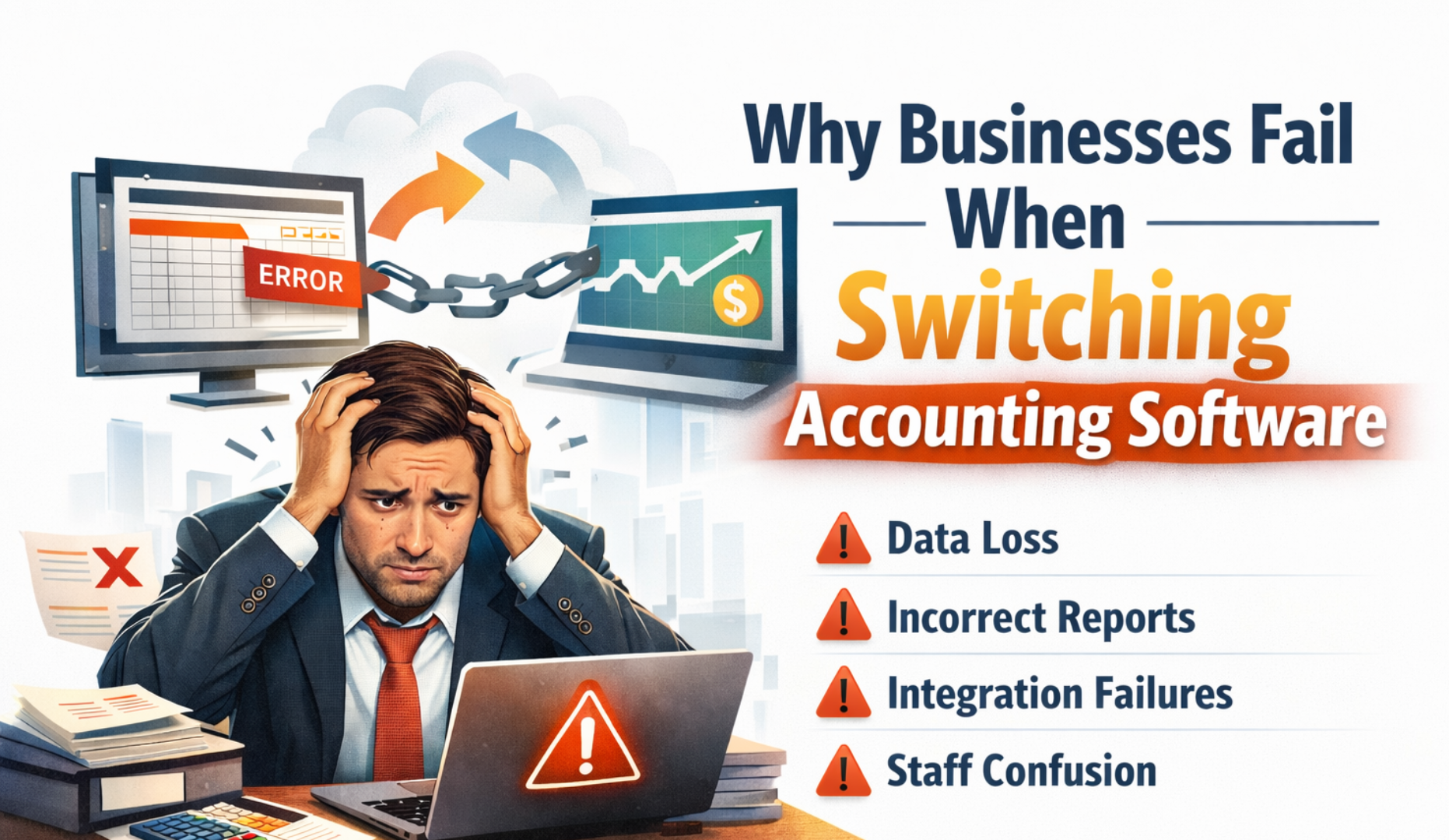
Problems such as missing data, incorrect reports, and broken integrations appear quickly after switching accounting software. As a result, business owners often lose confidence in the new system and struggle to manage their finances properly.
The truth is simple. Switching accounting software is not just a technical task. It is a financial data transition that requires planning, validation, and careful execution. When businesses underestimate the process, the migration often fails.
In this guide, we will explain why businesses fail when switching accounting software, the common mistakes that cause problems, and how companies can move to a new accounting system successfully.
Why Businesses Decide To Start Switching Accounting Software
Before looking at the failures, it helps to understand why companies start switching accounting software in the first place. Businesses rarely change systems without a good reason.
Growth is usually the biggest driver. A system that worked well for a small startup may no longer handle the needs of a growing company. As transactions increase and reporting becomes more complex, limitations begin to appear.
Many businesses also struggle with manual work. Older accounting systems often require repetitive data entry, which increases the risk of human error. Modern cloud accounting platforms automate many tasks and provide better real time insights.
Another reason businesses begin switching accounting software is poor reporting. Decision makers need accurate financial data. If the current system cannot provide clear reports, leaders cannot make informed decisions.
Some companies also face integration problems. Modern businesses rely on many tools such as ecommerce platforms, CRM systems, and payment gateways. When accounting software cannot connect properly with these systems, workflows become inefficient.
Common reasons businesses start switching accounting software include
• Outgrowing their current accounting platform
• Poor financial reporting features
• Too much manual bookkeeping work
• Lack of automation
• Difficulty integrating with other business tools
While these reasons are valid, the process of switching accounting software must be handled carefully to avoid serious financial issues.
The Hidden Risks Of Switching Accounting Software
At first glance, switching accounting software may seem straightforward. Businesses expect to export their data from the old system and import it into the new one. Unfortunately, the reality is rarely that simple.
Financial data is complex. Every transaction affects multiple reports, balances, and accounts. If even a small part of the migration goes wrong, the entire financial picture may become inaccurate.
One major risk during switching accounting software is data loss. Missing invoices, payments, or journal entries can create gaps in financial records. These issues often appear months later when reports do not match historical data.
Another common problem is incorrect opening balances. If balances are transferred incorrectly, financial reports will never match previous records. This makes reconciliation extremely difficult.
Integration failures also create major challenges. Businesses rely on tools such as ecommerce platforms and payment systems. When switching accounting software breaks these connections, operations slow down.
Staff confusion is another hidden issue. Employees must learn the new system quickly. Without training, teams often continue making mistakes long after the migration is complete.
Some common risks during switching accounting software include
• Loss of financial data
• Incorrect opening balances
• Broken integrations
• Inaccurate financial reports
• Staff struggling with the new system
Understanding these risks is the first step toward avoiding migration failures
Top 8 Reasons Businesses Fail When Switching Accounting Software
Many companies begin switching accounting software with good intentions but run into serious problems during the process. Below are the most common reasons migrations fail.
1. Poor Planning Before The Migration
The biggest mistake businesses make when switching accounting software is rushing into the process without a clear plan.
A proper migration requires preparation. Businesses must decide which data should move, how historical transactions will be handled, and how reports will be validated.
Without this planning, the migration becomes chaotic. Important records may be missed, and financial reports may not match the previous system.
2. Dirty Or Inaccurate Financial Data
Another major reason switching accounting software fails is poor data quality.
If the original system contains errors, duplicates, or incorrect balances, these issues will simply transfer to the new platform. In some cases, the problems become even worse after migration.
Before switching accounting software, businesses must review and clean their financial data carefully.
3. Missing Historical Records
Historical data plays an important role in financial analysis. However, many companies do not plan how historical transactions will be handled during switching accounting software.
Some businesses migrate only opening balances, while others move several years of transactions. If the approach is unclear, important records may be lost.
4. Choosing The Wrong Accounting Software
Sometimes the problem is not the migration itself but the new platform.
Businesses may begin switching accounting software without fully understanding the features of the new system. As a result, they move to a platform that does not support their workflow.
Choosing the right software requires careful evaluation of business needs, integrations, and reporting requirements.
5. Ignoring Integrations And Apps
Modern accounting software rarely operates alone. Businesses often rely on tools such as ecommerce systems, inventory platforms, and payment gateways.
During switching accounting software, these integrations must be reviewed carefully. If they are ignored, connections may stop working after the migration.
6. Lack Of Staff Training
Even the best accounting software will fail if the team does not understand how to use it.
When businesses rush through switching accounting software, staff training is often overlooked. Employees continue using the system incorrectly, which leads to reporting errors.
7. Weak Data Validation After Migration
A successful migration does not end when data is imported. Validation is critical.
Businesses must compare reports between the old and new systems to ensure everything matches. Without this step, errors may go unnoticed.
8. Trying To Do Everything Alone
Many businesses attempt switching accounting software without professional guidance. While this approach may seem cost effective, it often leads to mistakes.
Migration specialists understand data structures, platform differences, and validation processes. Their experience helps avoid costly errors.
Real Problems Businesses Face After Switching Accounting Software
When migration mistakes occur, businesses quickly notice the impact. Financial systems that should improve efficiency instead create confusion.
One common problem after switching accounting software is missing invoices. Sales records may not transfer properly, causing revenue reports to appear incorrect.
Duplicate transactions are another frequent issue. When data imports are not configured correctly, the system may create multiple copies of the same transaction.
Inventory errors also appear in many migrations. If stock levels are not transferred correctly, businesses may lose track of product quantities.
Tax reporting can also become problematic. Incorrect tax codes or missing transactions may cause VAT or sales tax reports to produce inaccurate results.
Some real problems businesses face after switching accounting software include
• Missing invoices or payments
• Duplicate financial transactions
• Inventory balances that do not match stock records
• Financial reports that differ from the old system
• Tax reports showing incorrect values
These issues demonstrate why switching accounting software requires careful planning and verification.
Best Practices For Switching Accounting Software Successfully
The good news is that most migration problems can be avoided with the right approach. Businesses that follow best practices can transition smoothly to a new accounting system.
The first step before switching accounting software is reviewing existing financial data. This process helps identify errors, duplicates, or incorrect balances that must be fixed before migration.
Next, businesses should define exactly what data will move to the new system. This includes contacts, invoices, bills, payments, and journal entries.
Cleaning financial data is also essential. Removing unused accounts and correcting mistakes will make the migration more accurate.
Testing the migration is another important step. A sample data transfer allows businesses to identify problems before performing the full migration.
After switching accounting software, validation becomes critical. Financial reports such as profit and loss, balance sheet, and trial balance should match the previous system.
Finally, businesses should provide proper training to their staff. When employees understand the new platform, they can use it more effectively.
Key best practices for switching accounting software include
• Review financial data before migration
• Clean accounts and correct errors
• Define what data will be transferred
• Test the migration process
• Validate reports after migration
• Train the team on the new system
Following these steps greatly increases the chances of a successful migration.
When Businesses Should Consider Professional Migration Help
Some migrations are relatively simple. However, many businesses face complex scenarios that require professional support.
For example, companies with large transaction volumes often struggle with switching accounting software. Moving thousands of invoices, bills, and payments requires advanced migration tools.
Businesses using multiple integrations also face challenges. Ecommerce platforms, payment systems, and CRM tools must connect properly with the new accounting system.
Multi currency accounts create additional complexity. Currency conversions and historical exchange rates must be handled carefully.
Inventory based businesses also require careful planning when switching accounting software. Product quantities, purchase records, and cost calculations must remain accurate.
Professional migration specialists help businesses manage these challenges and ensure the transition is completed correc
How eCloud Experts Help Businesses Switch Accounting Software Safely
At eCloud Experts, the goal is to make switching accounting software accurate and reliable for growing businesses.
Our migration specialists analyze the existing accounting system before the process begins. This helps identify potential issues and determine the best migration strategy.
We then prepare financial data for transfer. This step includes reviewing accounts, cleaning data, and ensuring balances are correct.
Once the preparation stage is complete, our team performs the data migration using structured methods. Transactions, contacts, invoices, and other financial records are transferred carefully.
After switching accounting software, we verify every report. Profit and loss statements, balance sheets, and trial balances are compared with the original system to ensure accuracy.
Our team also helps businesses reconnect integrations and train staff on the new platform. This ensures the accounting system works smoothly after the transition.
By combining technical expertise with careful validation, eCloud Experts helps businesses switch accounting systems with confidence.
Final Thoughts
Switching accounting software can be one of the most valuable improvements a business makes. A modern accounting platform provides better automation, clearer financial insights, and stronger business control.
However, the process requires careful planning and execution. Without preparation, switching accounting software can lead to missing data, inaccurate reports, and operational disruptions.
Businesses that clean their data, test migrations, validate reports, and train their teams will achieve far better results.
If your company is planning to start switching accounting software, expert support can make the difference between a smooth transition and a costly failure.
Contact eCloud Experts today to ensure your accounting software migration is accurate, secure, and built for long term success.