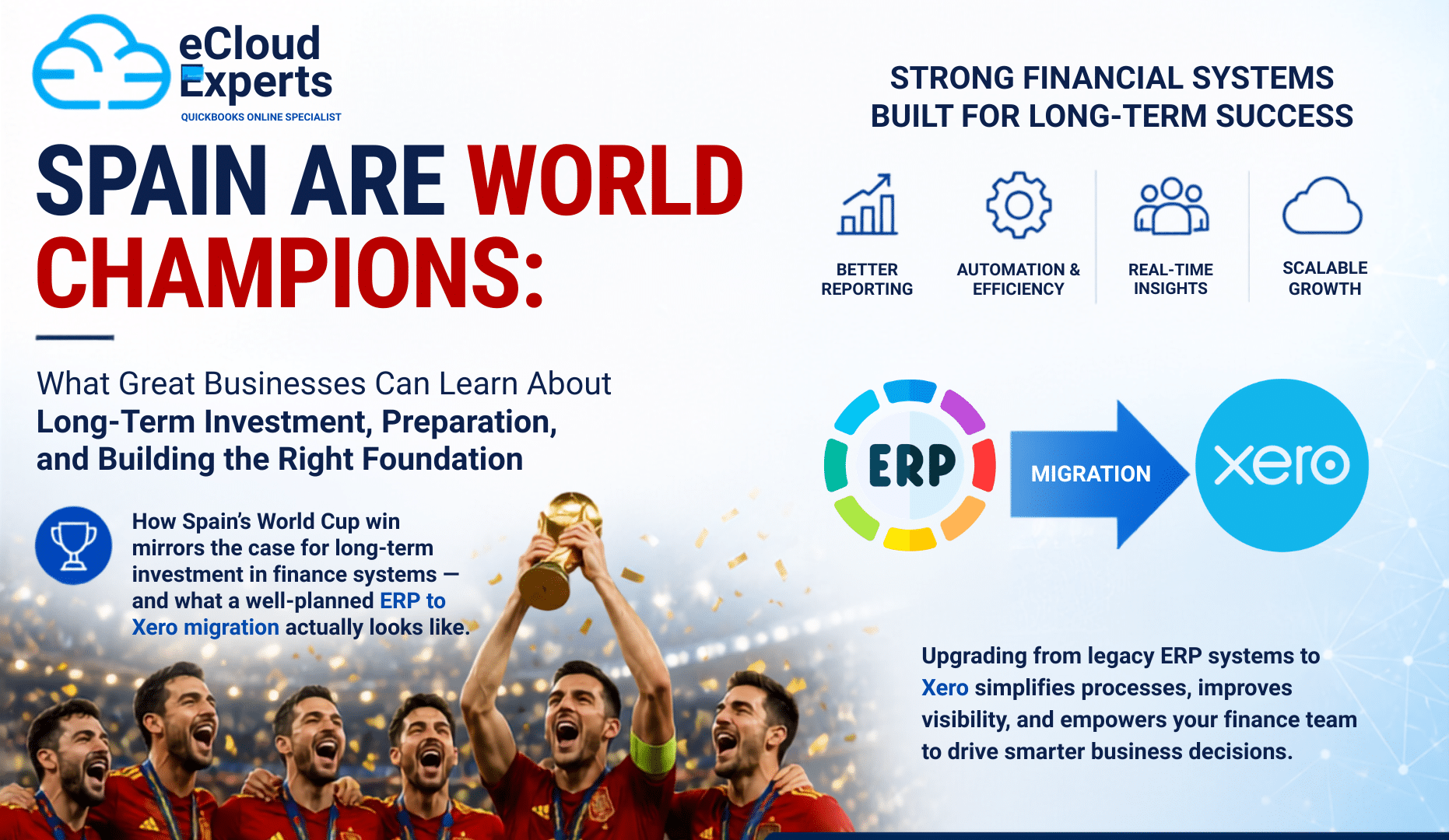
How Spain’s World Cup win mirrors the case for long-term investment in finance systems — and what a well-planned ERP to Xero migration actually looks like.
Spain are world champions once again.
It’s tempting to focus only on the final whistle. The trophy lift, the celebrations, and the headlines naturally attract the most attention. Yet those moments represent only a small part of the story. Spain won the World Cup because of decisions made years earlier. Coaches, leaders, and administrators invested in academies, training grounds, and long term planning. Those decisions, not any single match, laid the foundation for success.
Spanish football didn’t get here by chance. For years, it has invested in youth development, technical excellence, and a clear, consistent playing philosophy. It didn’t build a winning team overnight. It built a system — one that reliably produces world-class talent, tournament after tournament, generation after generation.
Businesses face exactly the same challenge, whether they realise it or not. And finance teams, in particular, have a lot to learn from how champions are actually built. This isn’t really an article about football. It’s an article about why the businesses that win — the ones with the fastest month-end close, the clearest reporting, the strongest cash flow, and the calmest finance teams — are rarely the ones working the hardest. They’re the ones working with better systems, built well in advance of when they’re needed.
Success Is Never a Single Decision
There’s a myth in business that transformation happens in one dramatic moment: the big hire, the big client win, the big software switch. In reality, sustainable success is built from thousands of small, correct decisions made consistently over a long period of time.
Spain’s route to the World Cup didn’t hinge on one moment of brilliance. Years of investment in coaching pathways, a clear playing philosophy across every age group, and a culture that valued technical excellence over shortcuts laid the foundation for success. Every pass in the final reflected more than a decade of preparation that most people never saw.
Growing businesses work the same way. There is rarely one decision that transforms a company overnight. Instead, success comes from consistently improving every part of the business — including the parts that don’t get much attention until something goes wrong.
For finance teams, one of the most overlooked opportunities for this kind of quiet, compounding improvement is the finance system itself.
Why “It Still Works” Isn’t a Strategy
Many companies delay upgrading their finance systems for a simple reason: the current one still “works.” Invoices go out. Payroll gets processed. The accounts eventually close. Nothing is on fire, so why touch it?
But just as Spanish football continually evolved rather than resting on past success, growing businesses need systems that support where they’re heading — not just where they’ve been.
An ERP system may have served your business brilliantly for years. But as an organisation grows, the demands on its finance function change, often faster than anyone notices in the moment. Complexity creeps in gradually, and then all at once:
- Multiple entities that need to be reported on individually and consolidated together
- Multi-currency transactions as international trading relationships expand
- International operations spanning different tax regimes, currencies, and reporting standards
- Complex reporting requirements from investors, boards, or lenders
- Slower month-end closes, as manual processes strain under growing transaction volumes
None of these arrive as a single crisis. They accumulate. A finance team that was comfortably keeping pace two years ago can suddenly find itself permanently behind, firefighting instead of forecasting — not because anyone did anything wrong, but because the system underneath them never evolved to match the business growing on top of it.
This is usually the point at which businesses start looking seriously at Xero, the cloud accounting platform designed to scale with growing organisations.
What Legacy Systems Actually Cost You
It’s worth being specific about what “the current system still works” actually means in practice, because it rarely means what it sounds like.
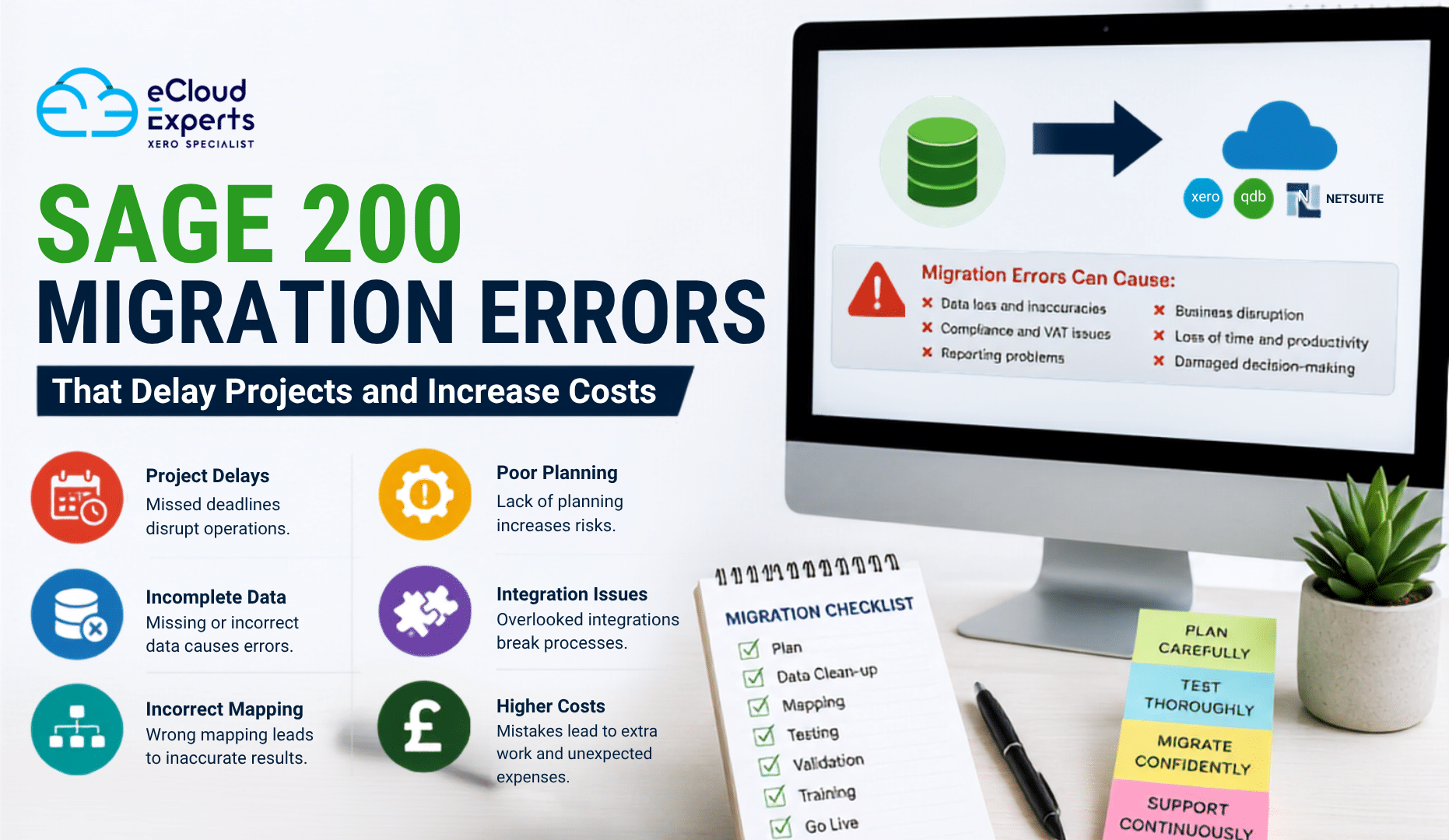
Many businesses are running legacy ERP systems that have become expensive to maintain, difficult to customize, and increasingly mismatched to their current needs. The system technically functions. But underneath that surface-level functionality, a familiar set of problems tends to build up:
- Manual reporting that takes days to compile and is often out of date before it’s even finished
- Duplicate data entry across disconnected systems, with all the errors and wasted hours that come with it
- Complex approval processes that slow decision-making at exactly the moments speed matters most
- High software costs, particularly for legacy licensing, maintenance contracts, and specialist consultants
- Limited real-time visibility, leaving leadership making decisions on numbers that are weeks old
None of these show up as a single dramatic failure. They show up as a slow tax on the business — a few extra hours here, a delayed decision there, a report nobody quite trusts. Over time, that tax compounds, in exactly the same way good habits compound in the other direction.
What Modern Cloud Accounting Actually Changes
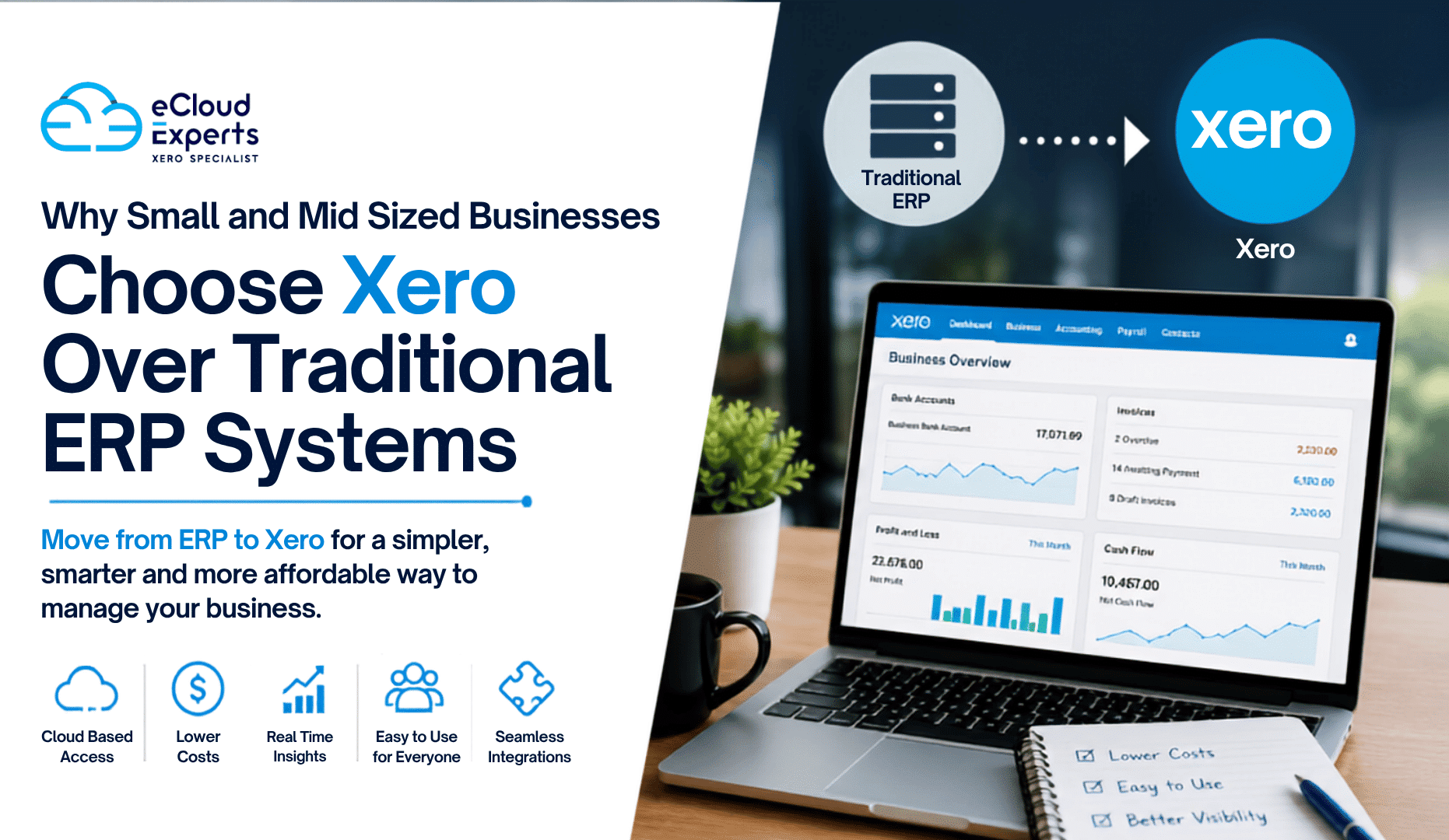
Modern cloud accounting has changed what’s realistically possible for finance teams, and the gap between legacy ERP and a modern platform like Xero is now substantial. By migrating from ERP to Xero, businesses typically gain:
- Real-time financial reporting, so decisions are made on current numbers, not last month’s
- Automated bank reconciliation, removing hours of manual matching every week
- Multi-entity reporting, built for groups rather than bolted on afterwards
- Cloud access from anywhere, supporting remote and hybrid teams without compromise
- Powerful integrations with payroll, expenses, inventory, and reporting tools, so the finance system becomes a genuine hub rather than an isolated island
The benefits extend well beyond the accounting function itself. Businesses that make this move consistently report:
- Faster decision-making, because leadership isn’t waiting weeks for numbers
- Better management reporting, with dashboards instead of static spreadsheets
- Easier collaboration between finance and remote or distributed teams
- Lower IT overheads, without the cost of maintaining legacy infrastructure
- Scalable cloud infrastructure that grows with the business instead of constraining it
- Seamless integration with hundreds of everyday business applications
Migration Is an Opportunity, Not Just an Upgrade
It’s worth being clear about something: migrating from an ERP to Xero isn’t simply changing software. Treated properly, it’s an opportunity to simplify processes, improve visibility, automate manual tasks, and free up a finance team’s time to focus on strategic work rather than administrative firefighting.
That distinction matters. A migration done badly just moves the same problems onto a new platform with a nicer interface. A migration done well uses the transition as a genuine reset point — a chance to ask which processes actually still make sense, which reports people actually use, and which approval chains exist for good reason versus historical accident
At eCloud Experts, a Xero Gold Champion Partner, ERP to Xero Migration isn’t just about importing data from one system to another. We review your existing finance processes, simplify them where possible, and build your new Xero environment to support long-term growth instead of copying old habits into a new system. Talk to our migration experts today.
Because moving systems should improve your business — not just relocate it.
Experience Across Every Legacy System
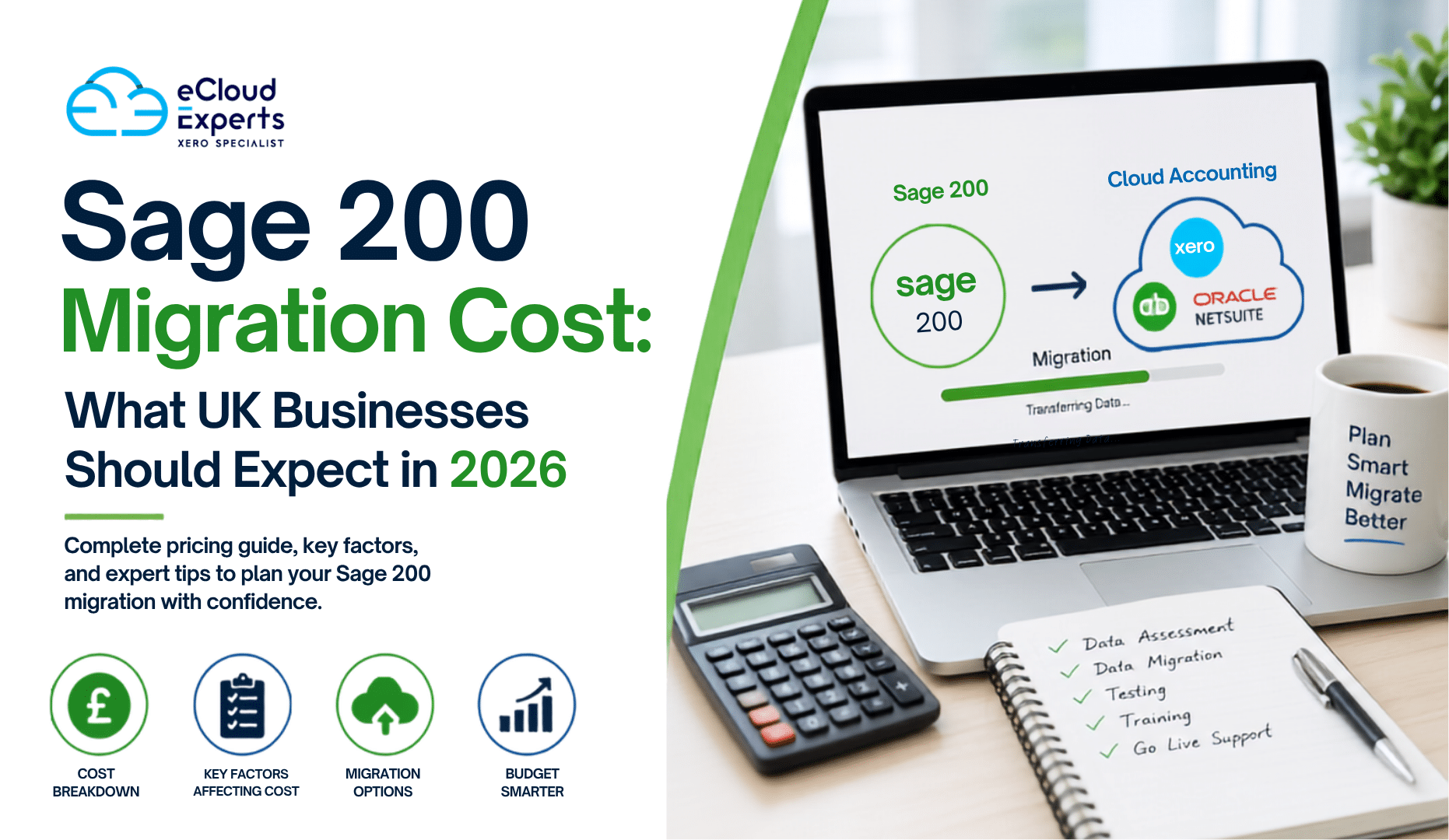
We’ve helped businesses migrate from a wide range of legacy ERP and accounting platforms, including:
- SAP Business One
- Oracle NetSuite
- Microsoft Dynamics NAV & Business Central
- Sage 200
- Sage Intacct
- Pegasus Opera
- Exchequer
- Access Financials
- MYOB
- QuickBooks Enterprise
And many more besides. That range matters, because every legacy system carries its own quirks, its own historical workarounds, and its own data structures that need careful handling during ERP to Xero Migration. Experience across this range means fewer surprises, less disruption, and a smoother transition for your team.
We’ve completed ERP to Xero migrations for businesses in manufacturing, retail, healthcare, hospitality, SaaS, and professional services. We also support international groups. You can explore our client case studies for real examples. Whether you’re moving one company or twenty entities, the same principle applies. Careful planning makes the migration far less disruptive than most businesses expect.
That’s where experience matters most — not in the mechanics of moving data, but in anticipating the questions and edge cases before they become problems.
The Best Teams Don’t Wait Until Everything Breaks
There’s a pattern worth noticing in how genuinely excellent organisations — on a football pitch or in a finance department — actually operate. They don’t wait for a crisis to force change. They improve while they’re already succeeding, precisely because that’s when they have the resources, the headspace, and the stability to do it properly.
Spain didn’t overhaul their footballing philosophy after a disappointing tournament out of desperation. Instead, they spent years investing in youth development and technical foundations, even while the senior team continued to perform well. That long term commitment created a system that delivered sustained success instead of simply responding to setbacks.
Finance teams that wait until the month end close becomes genuinely unmanageable, or until unreliable numbers derail a board meeting, make the change under pressure with less time, less patience, and less room to get it right. The businesses that handle this transition best start the conversation long before it becomes urgent.
Building the Right Foundation
Behind every trophy are thousands of small decisions made correctly over many years. Business growth works in the same way. One decision rarely transforms a company overnight. Success comes from improving every part of the business consistently, including the less visible areas that receive little attention but quietly shape everything else.
For finance teams, replacing an outdated ERP with a modern cloud platform like Xero is one of those foundational improvements. It won’t make headlines internally the way a big client win does. But it changes what’s possible for every decision that follows — faster, betterinformed, less encumbered by manual process.
Spain became champions by building the right foundation, years before anyone was paying attention to the outcome. If your business is preparing for its next stage of growth, ask whether your finance system will support where you’re going or simply meets the needs of where you’ve already been.
What a Well-Planned Migration Actually Looks Like
It’s easy to talk in generalities about “smoother transitions” and “minimal disruption.” In practice, a well-run ERP to Xero Migration tends to follow a fairly consistent shape, regardless of the industry or the size of the business involved.
It starts with discovery, not data extraction. Before anything is moved, the priority is understanding how the business actually operates today — which reports leadership genuinely relies on, which approval workflows exist for good reason, which manual processes have grown up around gaps in the old system, and which numbers matter most to the people making decisions. Skipping this step is the single most common reason
migrations go badly: teams end up replicating old inefficiencies in a shinier system.
It maps entities and structures early. For businesses running multiple companies, subsidiaries, or international operations, getting the entity structure right in Xero from day one avoids painful rework later. This is particularly important for groups with intercompany transactions, shared services, or consolidated reporting requirements.
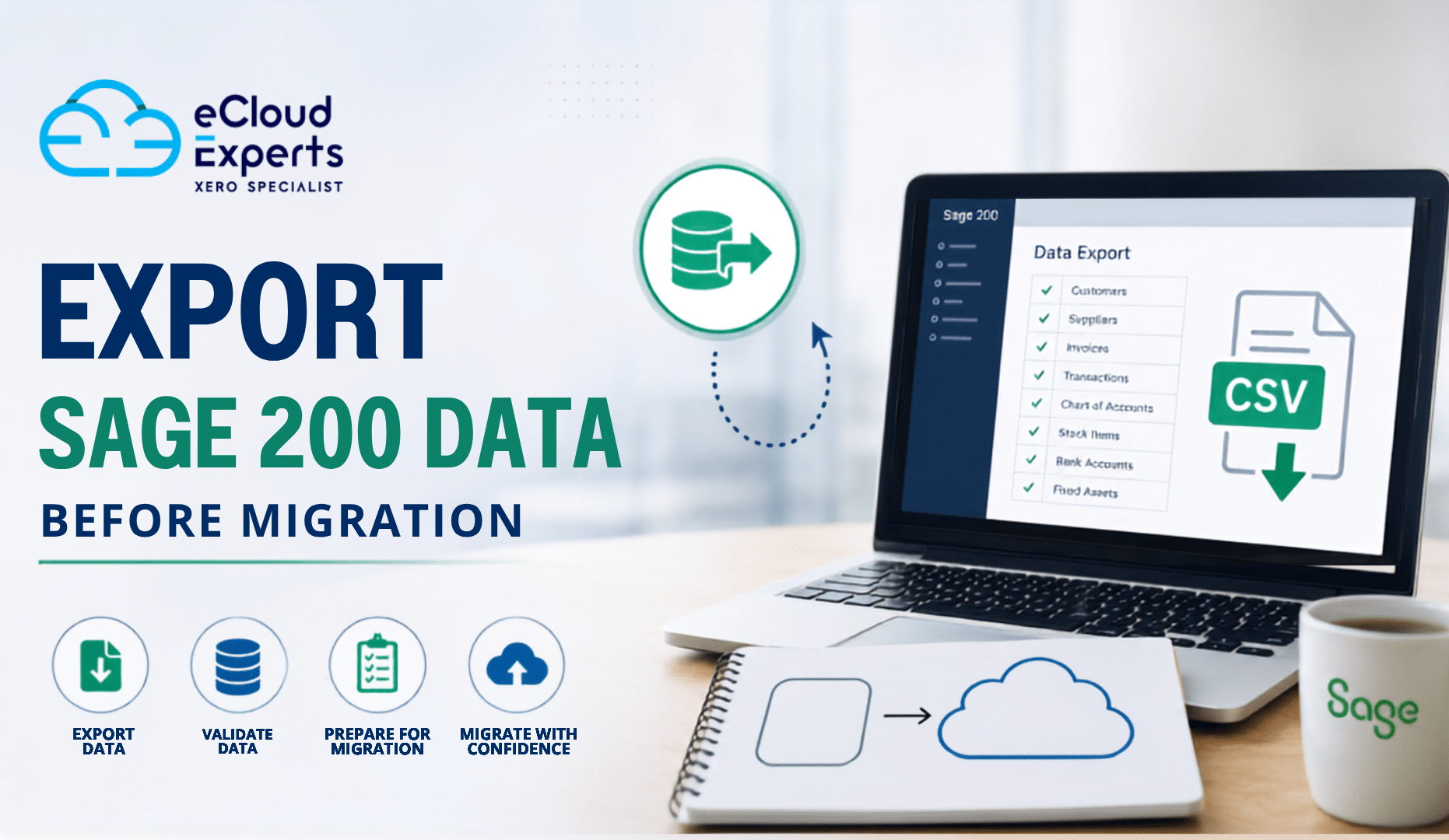
It treats data migration as a quality exercise, not just a copy-paste job. Historical data rarely arrives clean. Part of the value of a properly managed migration is using it as an opportunity to correct long-standing errors, reconcile discrepancies, and retire data that no longer serves a purpose — rather than faithfully importing years of accumulated mess into a new system
It builds in parallel running and testing. Rather than switching everything over in one leap
of faith, well-planned migrations typically run old and new systems alongside each other for
a period, allowing discrepancies to be caught and resolved before the legacy system is
switched off entirely.
It includes proper training, not just system access. A new system only delivers value when the team knows how to use it effectively. Businesses often miss quick wins by investing in a better platform but failing to give their finance teams enough time and support to learn its capabilities. Match the training to the team. Some people learn best through hands on workshops, others prefer self paced reference material, and most achieve the best results by combining both.
It doesn’t stop at go-live. Post-migration support matters as much as the migration itself. New systems reveal new questions in the first few months of real use — questions that don’t come up in testing but do come up in a live month-end close.
Common Concerns, Addressed Honestly
Businesses considering a move away from a legacy ERP tend to raise similar concerns, and it’s worth addressing them directly rather than glossing over them.
“We’ve customised our current system extensively — won’t we lose functionality?” Sometimes, yes, in the narrowest sense. But heavy customisation is often itself a symptom of a system that was never quite right for the business, with workarounds layered on top of workarounds over years. Migration is usually the moment to ask whether that functionality is genuinely essential, or whether it exists simply because nobody has had the opportunity to question it.
“Our reporting requirements are complex. Can Xero really handle multi entity, multicurrency reporting?” In many cases, yes. Success depends on planning the migration around your entity structure and reporting requirements from the beginning, while using the right add on tools where they add value. That’s why we carry out detailed discovery before the migration starts, ensuring we address complex reporting needs early instead of uncovering them after go live.
“We can’t afford disruption during a busy period.” This is a fair concern, and it’s exactly why timing and parallel running matter. A properly planned ERP to Xero Migration is scheduled around the business’s calendar, not the other way around, with contingency built in so that a live month-end or payroll run is never put at risk.
“Our team is comfortable with the current system — won’t there be resistance to change?” Some resistance is natural and healthy; it usually reflects genuine concern about losing capability, not simple reluctance to learn something new. Addressing it well means involving the finance team early, being honest about what will change, and investing properly in training rather than treating it as an afterthought.
The Long Game
None of this happens in a single conversation or a single weekend cutover. The businesses that get the most value from moving to Xero are the ones that treat it the way Spain’s football federation treated youth development: as a long-term investment in a system that will keep paying returns long after the initial effort is forgotten.
That’s really the point underneath all of this. Champions — whether on a football pitch or in a finance department — aren’t built by chasing a single moment of validation. They’re built by consistently choosing to improve the foundation, even when nothing is currently broken, because that’s precisely when there’s the most room to do it well.
Frequently Asked Questions
How long does an ERP to Xero Migration take?
It depends on the number of entities, the volume and cleanliness of historical data, and how many integrations are involved. A singleentity business can often migrate within a few weeks, while a multi-entity group with complex reporting requirements may take a few months when planned properly, including parallel running and training
Will we lose historical data when we migrate from our ERP to Xero?
No — historical data is migrated, not discarded. In practice, migration is also an opportunity to reconcile and clean up historical records rather than carrying old errors forward unchanged. How much historical detail is imported versus archived is a decision made during the discovery phase, based on what your business actually needs for reporting and audit purposes.
Can Xero handle multi-entity and multi-currency accounting?
Yes. With the right setup — and, where needed, supporting add-ons — Xero supports multi-entity structures, consolidated group reporting, and multi-currency transactions. Getting this right depends heavily on how the entity structure is mapped during ERP to Xero Migration planning.
Is Xero suitable for businesses that have outgrown QuickBooks, Sage, or NetSuite?
Yes, this is one of the most common migration paths we support. Businesses moving from platforms like Sage 200, Sage Intacct, NetSuite, Microsoft Dynamics, or QuickBooks Enterprise typically do so because their reporting, automation, or multi-entity needs have outgrown what those systems handle well.
Will migrating disrupt our current month-end close or payroll?
No, as long as you plan the migration around your business calendar. We keep your legacy system and Xero running side by side for a period. This parallel running approach helps protect live processes such as payroll and month end close. It also gives your team time to identify and resolve any issues before retiring the legacy system.
Do we need to train our whole finance team before switching to Xero?
We strongly recommend training, but we tailor the format to your team. Some teams benefit from hands on workshops, while others prefer self paced resources. Many achieve the best results by combining both. Businesses that skip training often miss the full value of their new system after migration.
What do eCloud Experts actually do during a migration, beyond moving data?
We review your existing finance processes and simplify workflows where possible. We also manage parallel running and testing, provide practical training, and continue supporting your team after go live. For a detailed overview, explore our ERP to Xero Migration services.
Ready to Talk?
Thinking about moving from your ERP to Xero? At eCloud Experts, we’d be happy to talk through what that would actually look like for your business — no obligation, just a conversation about where you are now and where you want to get to.
Ready to migrate from your ERP to Xero? Let’s have a conversation.
eCloud Experts is a Xero Gold Champion Partner specialising in ERP to Xero Migration, bookkeeping, payroll, multi-entity accounting, and finance transformation.