Xero Accountant | Xero Migration | Xero Support | Xero Training | Crypto Accounting
+44 0203 488 6202
info@ecloud-experts.com

- Aqilla to Xero
Aqilla to Xero migration Service
A reconciliation-led migration for finance teams simplifying off Aqilla’s multi-dimensional accounting — every fund, project and cost-centre code mapped to its new home in Xero before go-live.

Xero Gold Champion Partner

Xero Migration Specialists

AAT Licensed Accountant
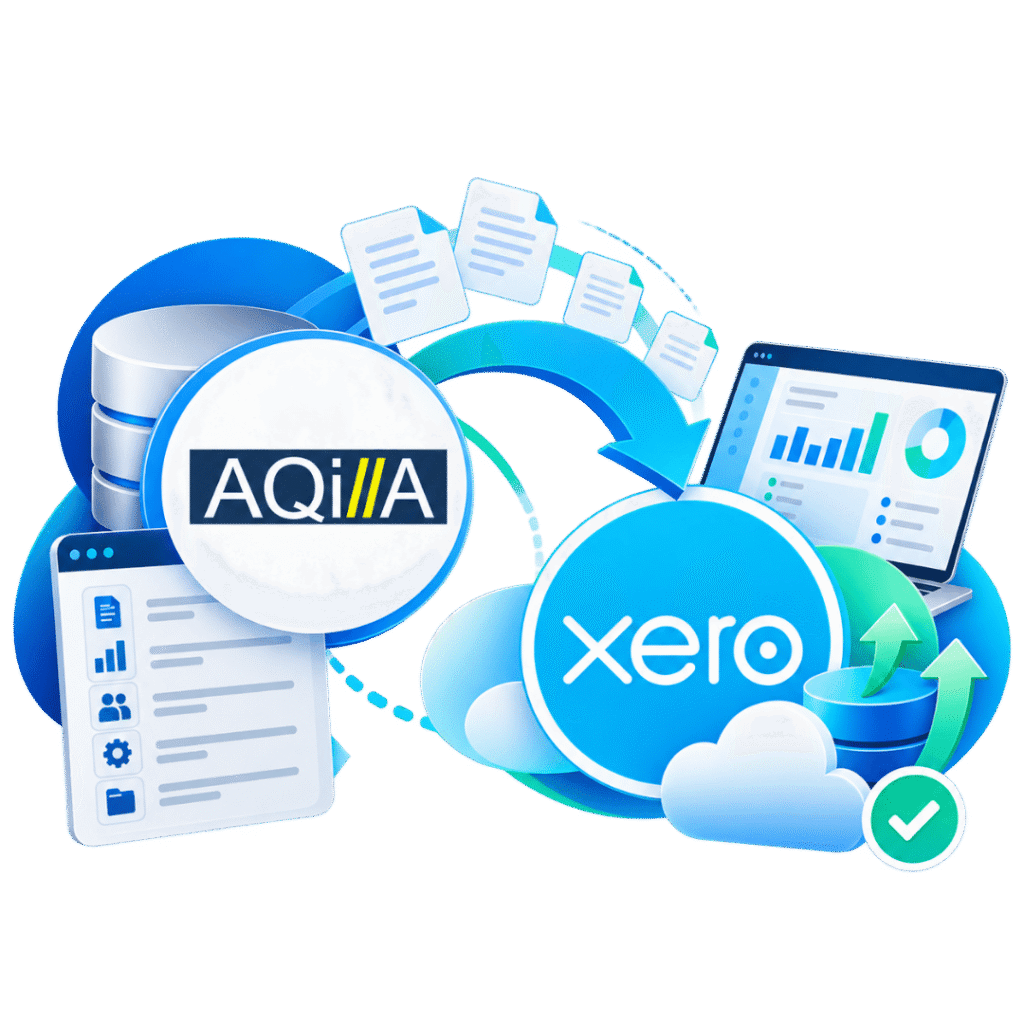
What we migrate
Agreed entities, ledgers, transactions and analysis history
Complexity handled
Dimension mapping, multi-entity consolidation and funds
How we validate
Comparative control totals and a signed-off mapping register
What you receive
Configured Xero, dimension mapping and post-migration support
Clients We Migrated into Xero




















What our client Says
Posted on Google
 MR. Makuri
 eCloud Experts handled our Xero migration really well. Everything was transferred correctly, and they kept us updated throughout the process. Very helpful and easy to work with.Posted on Google
 ahmed rakinWe used eCloud Experts to migrate our accounts to Xero and the whole process was handled extremely well. They explained what needed to be done, transferred the data carefully and made sure everything was reconciled correctly before completion. The team clearly has strong Xero migration experience and was responsive whenever we had questions. I would highly recommend eCloud Experts to any business moving to Xero.Posted on Google
 Masum AhmedI contacted eCloud Experts because I needed help with crypto accounting and tax matters and wanted an accountant who actually understood cryptocurrency transactions. They were knowledgeable, patient and explained everything clearly. They helped organise the records and made a complicated situation much easier to manage. Highly recommended for anyone needing specialist crypto accounting support.Posted on Google
 Amolesh Chandra PaulEcloud Experts has been an exceptional partner in managing our accounting needs with Xero. Their deep expertise and hands-on support have made a significant difference in streamlining our financial processes. From setup to ongoing assistance, their team has been responsive, knowledgeable, and efficient. They take the time to explain everything clearly, making Xero easy to use, even for beginners. Their proactive approach ensures that our accounts are always in order, allowing us to focus on growing our business. If you're looking for reliable Xero experts, I highly recommend Ecloud Experts!Posted on Google
 Betty KellyZakir and Aman worked really hard to get us moved from Netsuite to Xero. They were fantastic, supportive and worked fast and took the complication of a migration away for us. We highly recommend them to anyone wanting to move to Xero!Posted on Google
 Charlotte PownallHighly recommended. Utterly helpful, so informative, extremely quick to respond to a meeting/queries.Posted on Google
 Tom WraggRecently had Xero Experts training with Zakir - he was excellent and thorough throughout would highly recommend.Posted on Google
 abdur rokibeCloud and their experts, notably Zakir, have been exceptional in facilitating our migration from Sage 50 to Xero. The intricate process of transferring multiple years of multi-currency data was executed with utmost precision and expertise. I wholeheartedly vouch for their servicesPosted on Google
 Laura RichardeClound and Zakir in particular have been very helpful in assisting our migration from X3 to Xero. In particular teh complicated migration of several years of multi-currency data was handled very well. I would not hesitate to recommend them.Posted on Google
 Liam HBrilliant service. Zakir helped me with compiling and submitting a crypto tax return that I was struggling to do myself. There were many transactions across various activities which can be a bit overwhelming from an accounting perspective. Zakir was able to make sense of everything and submit to HMRC on my behalf, all for a reasonable price. If I need help in the future with another return, I will be coming back to eCloud.Posted on Google
 Stephen PittZakir, was very helpful and knowledgeable. Training was structured to exactly what I needed.Posted on Google
 Nikola BennGreat basic training on Xero, very professional and knowledgable. Thank you ZakirPosted on Google
 Craig ReidWe are a small charity and a limited company by guarantee so it was really important for us to get the right accountancy software. It was recommended for us to use Xero. The Xero software training we had on Friday 4th November went really well and we would highly recommend it, and it helped to empower our understanding of all the features on Xero. The trainer is also very patient and he helps you by working at your pace. It’s a great software to start to process your accounts and it also saves loads of time. This will get you on the right track with the help of financial reports and many other great reports if you need them. Thank you again for all your time. Janette Craig and Ruth at Dennyloanhead Community HallPosted on Google
 Helen ZumanZakir was patient and knowledgeable. He helped me with my specific problems and also helped me understand Xero better. I appreciate his help!Posted on Google
 katie lyonsExtremely helpful - thanks Zakir!Posted on Google
 khyati LathigraI needed quick help with realised/unrealised gains and also some other accounting reports issues, Zakir was very much helpful! Even though he wasn't feeling well still decided to join in the meeting and help me out on every single questions I asked. I would highly recommend to anyone who is not familiarise with Xero, Zakir is definitely an expert and you will be 100% satisfy from the service he can offer.Posted on Google
 chris woodZak was very helpful when i got myself into a pickle, he managed to rectify the issue and tweaked a few other bits. I will definitely be using againPosted on Google
 Ollie SmedleyI needed a little help / assurance with my VAT set-up. Zak spent an hour checking things through and made some useful suggestions for other Xero features I could use as well.Posted on Google
 Galin LoweZak is patient and thorough, I would highly recommend his services.Posted on Google
 Michael PostleA truly value add training programme - thank you ZakirPosted on Google
 Carol SullivanThe training with Zak was spot on. Luckily I had one to one, so I was able to ask lots of questions that were relevant to our business. Very impressed & stress free!Posted on Google
 Marion BrowneVery helpful and very knowledgeable about Xero. Would definitely recommend.Posted on Google
 Norma MartinZac has helped me so much with my training in Xero, I now understand the processes and the system so much better. Also very useful tips for shortcutsPosted on Google
 Drew RetfordVery helpful for anyone new to using Xero. Highly recommend!Posted on Google
 Sam SingletonWe are currently undergoing a Sage > Xero migration and have just completed the Basic training with Zakir. A very laid back 1-2-1 session with the department going through all the basics. A really good session and look forward to doing the Advanced training in a few weeks. I would definitely recommend using them!Posted on Google
 Russell Cassleton ElliottZakir was superb, as he led me through the Xero maze very effectively, as I am a complete novice at Xero. I cannot recommend Zakir and his service more. This is the best service for a beginner like me!Posted on Google
 NazmulWe used Xero Experts for our migration from QuickBooks to Xero. They were excellent – kept me informed and were very helpful. I would highly recommend them, saved us a great deal of mine and effort. Would certainly use them againPosted on Google
 Steve VentonI had a very obscure question that Zak help me with at very short notice, late one evening. Thank you.Posted on Google
 George KainI have worked with Zak on several different Xero support and training sessions, including the Xero set up and the Payroll Set Up Service. Always very knowledgable and professional and is always available for any follow up support that is required. Highly recommend.Posted on Google
 ANIL SURMELIHappy to work with Zak. He is a complete expert on XERO. Highly recommend Xero Experts for anything you may need about Xero and migration.Posted on Google
 Sean CheungZack was amazing very helpful and problems solved!Posted on Google
 Stephen Coganused xero expert 3 times, they helped me understand xero step by step in manageable 1 hour sessions. good value for money.Posted on Google
 Will A.BlissZak helps us regularly with more complicated Xero issues we can't solve in house. He is professional and knowledgeable and we would recommend his services to anyone.Posted on Google
 Bluefish VibeZak and his team have been incredibly helpful with our migration of Xero and I would highly recommend them. Xero Experts is a great partner for our start-up company. They offer great value and support to cover our accounting needs. Our accountant Zak is always there to support us and answer all the beginner questions we have & their expertise with Xero makes everything faster and better!Posted on Google
 Hana RasselFantastic service from the team at Xero Experts. Absolutely first class - very helpful and knowledgeable support from these Xero advisorsPosted on Google
 Abu RasselIt has been an absolute pleasure working with Zak. They have supported me greatly with getting to grips with Xero. A massive thank you from me!Posted on Google
 Warkan HasanI took complete Xero training (online live) with Xero Experts. I Enjoyed the comprehensive introduction to Xero Accounting Software, a good match of what I was expecting, well explained. I feel confident having to do payroll in Xero.
- Direct answer
Can Aqilla be migrated to Xero?
Yes. Aqilla’s ledgers, transactions, balances and analysis-coded history can be extracted, mapped and migrated into Xero, but the two platforms are not structural equivalents. Aqilla is built around unlimited analysis dimensions and real-time multi-entity consolidation; Xero is a single-entity platform with two tracking categories. A successful migration is a mapping exercise as much as a data-transfer one.
eCloud Experts starts by cataloguing every analysis dimension in active use, the entity structure, and any fund or grant reporting, before agreeing the target design and conversion period. We then transform the source data and reconcile the agreed control totals, documenting any dimension that cannot be represented exactly in Xero.
Not every dimension survives the move
Aqilla customers often track fund, project, department, location and grant on a single transaction line. Xero supports two active tracking categories per organisation. We decide with your finance team which two matter most, and where the rest go.
- The dimension problem
Where each Aqilla dimension typically lands in Xero
This is the decision that shapes the whole project. Get it right and reporting continues with minimal disruption; get it wrong and month-end reporting quietly breaks a few weeks after go-live.
| Aqilla dimension | Typical use | Common Xero destination |
|---|---|---|
| Fund | Restricted, designated or unrestricted charity funds | A tracking category, or a separate Xero organisation for a materially large fund |
| Project | Job-level or project-level profit and loss | Xero Projects, or a tracking category where job costing needs are simple |
| Department | Team or business-unit reporting | A tracking category |
| Location | Branch or site-level reporting | A tracking category, or a contact group where reporting needs are lighter |
| Grant | Funder-specific reporting and compliance | A connected grant-management or reporting application |
Most organisations can only carry two of these forward as native Xero tracking. The rest need a deliberate decision, not a default.
- Why now
Why organisations move off Aqilla
Aqilla customers rarely leave because the platform has failed them. The trigger is almost always a change in how much dimensional depth the business still needs.
Entity carve-out
A subsidiary separated from a group’s shared Aqilla tenant typically loses access and needs its own standalone Xero file quickly.
Simplifying after fund closure
A charity or NFP that has completed a major programme or consolidated its funds may no longer need extensive fund-level dimensional reporting.
Standardising a portfolio
Accountancy practices and PE-backed finance functions sometimes move a smaller entity onto Xero to match the rest of a client or portfolio group.
Licensing review
Aqilla is typically priced for its dimensional and consolidation depth. An entity that no longer needs that depth may find Xero plus apps more cost-effective.
- Migration suitability
Who should move from Aqilla to Xero?
The right question isn’t whether Aqilla data can be imported into Xero — it usually can. It’s whether two tracking categories and a single-entity file can carry the reporting the business actually still needs.
Strong Migration Candidates
- A single entity separated from a group's Aqilla tenant
- Charities or NFPs with two or fewer active restricted funds
- Reporting needs met by two tracking categories plus Projects
- Practices standardising several smaller clients onto Xero
- Groups reviewing cost once consolidation is no longer required
Needs deeper assessment
- Live multi-entity, multi-currency consolidation in daily use
- Multiple active restricted funds with funder-compliance reporting
- More than two analysis dimensions used in routine reporting
- Configured approval hierarchies built deep into Aqilla
- A requirement to retain live drill-down rather than archived detail
When staying on Aqilla may be better
Aqilla may remain the better fit while live multi-entity consolidation, several active funds, or more than two reporting dimensions are essential day to day.
Replacing that natively in Xero can mean several connected applications without a clear reduction in cost. Discovery should test whether the reporting need has genuinely simplified first.
- Aqilla versus Xero
Where Xero can be the better fit after simplifying
Xero doesn’t out-feature Aqilla on dimensional depth. The advantage shows up in cost and everyday collaboration once that depth is no longer required.
| Business need | Why Xero can be a better fit | What to assess before switching |
|---|---|---|
| Analysis & reporting depth | Aqilla attaches unlimited analysis dimensions to every line; Xero supports two active tracking categories per organisation. | Identify which two dimensions are business-critical and where the rest will go. |
| Multi-entity consolidation | Aqilla consolidates multiple companies in real time; Xero uses one file per organisation with no native consolidation. | Confirm whether a connected consolidation tool is required afterwards. |
| Licensing and cost | Aqilla is typically priced for dimensional and consolidation capability; Xero is priced per organisation on a monthly plan. | Compare realistic Xero-plus-app costs against current Aqilla licensing. |
| Drill-down & audit trail | Aqilla allows live drill-down from summary to source transaction; Xero’s audit trail is transaction-level but structured differently. | Decide whether historical drill-down must be replicated or archived instead. |
| Workflow & approvals | Aqilla includes configurable approval hierarchies; Xero relies on user roles and, for complex chains, a connected app. | Map current approval rules to Xero roles or a bills-approval application. |
| Fund & grant accounting | Aqilla supports dimensional fund tracking natively; Xero handles this via tracking, Projects, or a specialist charity app. | Confirm ongoing funder reporting requirements before choosing the approach. |
| Everyday collaboration | Xero’s simpler interface and wide bookkeeper familiarity suit smaller teams once deep dimensional reporting isn’t required. | Confirm which users still need multi-entity or multi-dimension visibility. |
Feature references checked against Xero UK accounting software information. Final capability depends on plan, region and connected applications.
- Migration scope
What transfers from Aqilla to Xero
Final scope depends on which dimensions are actively used, the entity structure, and the reporting outcome the business needs after cut-over.
| Data area | Typical migration treatment | Key control |
|---|---|---|
| Chart of accounts | Retain, consolidate or redesign the account structure for Xero’s model. | Account mapping approved before import. |
| Entities | Map each Aqilla company to its own Xero organisation. | Entity-to-organisation mapping and intercompany treatment agreed. |
| Analysis dimensions | Select up to two dimensions for Xero tracking; map the rest to contact groups, Projects, or a connected app. | Dimension-mapping register signed off by finance. |
| Customers & suppliers | Clean and migrate contact records, balances and payment terms. | Duplicates and inactive records reviewed. |
| Sales & purchase transactions | Invoices, bills, credit notes, receipts and payments for the agreed period. | AR and AP ageing reconciled at conversion date. |
| Bank & cash accounts | Historical transactions and balances, followed by an agreed live-feed cut-over. | Statements, ledger balances and outstanding items reviewed. |
| Manual journals | Transform journals into supported Xero entries with correct dates and narratives. | Trial balance and journal totals compared. |
| Multicurrency & intercompany | Preserve transaction currency and agreed exchange-rate treatment. | Base and foreign-currency balances checked per entity. |
| Funds & grants | Migrate closing fund and grant balances as agreed opening data. | Fund and grant totals reconciled to the general ledger. |
| Approval workflow & attachments | Rebuild critical approval rules in Xero or a connected app; migrate attachments where feasible. | Workflow equivalence and file counts recorded. |
- Complex migrations
Dimensions, consolidation and fund accounting
Dimension mapping & tracking redesign
We identify every dimension in active use, agree which two become Xero tracking categories, and document a destination for the rest — contact groups, Projects, or a connected reporting app.
Multi-entity consolidation
Each Aqilla company is assessed and normally becomes its own Xero organisation. Intercompany balances and any ongoing consolidated reporting need are reviewed separately.
Fund & grant accounting
Closing fund and grant balances move as agreed opening data. Ongoing reporting continues through tracking, Projects, or a specialist charity application, depending on funder requirements.
- Risk management
How we protect accounting integrity
- Written scope and dimension-mapping treatment agreed in advance
- Approved chart of accounts and tracking-category register
- Controlled trial migration for multi-entity or fund-heavy projects
- Comparative trial-balance checks at agreed conversion dates
- AR and AP reconciliation, including fund and grant balances
- Dimension totals reconciled to the general ledger before sign-off
- Exception log for dimensions, workflows and unsupported records
- Finance-team review and agreed sign-off process
Common problems we prevent
Aqilla-to-Xero migrations can go wrong when dimensions are mapped inconsistently across transactions, fund or grant balances go unreconciled, approval workflows disappear without a replacement, or multi-entity eliminations are handled differently across organisations.
A matching closing trial balance is essential, but it isn’t the only test: dimension totals, fund positions and everyday usability matter just as much.
Important: the final control pack depends on the agreed scope and the reports available from Aqilla. Any unresolved source-data issue is documented rather than silently forced into Xero.
Written scope and hosting details agreed
Approved chart of accounts and tax-code mapping
Controlled trial migration for complex setups
Comparative trial balance checked at the conversion date
AR / AP reconciled, including recurring templates
Bank and cash balances validated against statements
Exception log for unsupported App Store functionality
Sign-off from you before go-live
Most problems we see elsewhere come from incomplete self-hosted exports, missed recurring templates, merged multi-company data, or App Store functionality quietly dropped without a replacement. This checklist exists to catch those before go-live, not after.
In practice, reconciliation happens twice: once on a trial migration using representative data, and once on the final cut-over using your actual closing figures. The trial run exists specifically to surface problems while there's still time to fix the mapping — not on the day you're trying to switch off Akaunting for good. Only after both trial balances match, and you've reviewed the exception log, do we call it done.
- Controlled delivery
Our 10-stage Aqilla to Xero migration process
01
Discovery and objectives
Confirm entities, users, reporting priorities, integrations, compliance needs and go-live target.
02
Data & dimension assessment
Review company structure, analysis-code usage, volumes, workflows and source-data quality.
03
Scope & acceptance criteria
Agree the migration period, inclusions, exclusions and control reports.
04
Xero target design
Design organisations per entity, chart of accounts, tax settings and the two tracking categories.
05
Extraction & staging
Export agreed Aqilla data and analysis-coded history into controlled working copies.
06
Mapping & transformation
Finalise the dimension-mapping register and prepare exception schedules.
07
Trial migration
Load representative data, test outputs and resolve issues before final conversion.
08
Final migration & cut-over
Process the agreed closing data and coordinate bank feeds.
09
Reconciliation & sign-off
Compare trial balances, AR, AP, fund and dimension totals; document variances.
10
Training & support
Handover Xero, train the team on the new tracking structure and support go-live.
- Investment
What shapes an Aqilla to Xero quote
Every quote is scoped and fixed before work begins. The typical project falls into one of three shapes — the exact price depends on entities, dimensions and fund complexity.
Single-entity clean migration
One Aqilla company, two or fewer dimensions in active use. Usually the fastest, most contained scope.
Multi-entity or fund accounting
Several Aqilla companies, or active restricted funds needing dimension mapping and a consolidation review.
Complex dimensional & workflow migration
More than two dimensions in daily use, configured approval hierarchies, or grant-compliance reporting.
Request a quote below and we’ll map your Aqilla environment onto one of these shapes with a specific, fixed number.
- Evidence
Reconciliation discipline, not just data transfer
Aqilla migrations follow the same discipline as our published accounting-platform work: full trial-balance tie-out, a signed-off mapping register, and finance-team sign-off before go-live.
We don’t yet have a published Aqilla-specific case study to link here. Our published migrations off Sage 50, NetSuite and Acumatica follow the same reconciliation-led approach — browse them, or ask us for the latest Aqilla examples at discovery.

Experience
12+ years in cloud accounting

Partner status
Xero Gold Champion Partner

Specialist fit
Multi-entity & dimension-mapping projects

Every project
Reconciled control-total sign-off
- Why eCloud Experts
Accounting-led migration expertise
eCloud Experts is a Xero Gold Champion Partner with more than 12 years of cloud-accounting experience and a specialist team supporting migrations globally.
We work with finance teams, groups and accountancy firms on complex historical-data projects, including mid-market ERP moves from Sage 100. Delivery can be direct to the end client or provided as a white-label migration service for accounting practices.
- Xero-certified advisers and migration specialists
- Experience with Aqilla, NetSuite, Acumatica and other platforms
- Analysis-dimension and tracking-category redesign
- Multi-entity consolidation and fund-accounting capability
- Documented reconciliation and control reporting
- Tailored Xero training and post-go-live support
Related Xero Migration Case Studies
See how we have helped organisations move from complex accounting and ERP systems to Xero, including projects involving historical data, multiple entities, multicurrency and detailed reporting structures.
Core Technology Systems:
NetSuite to Xero
Core Technology Systems moved from NetSuite to Xero with full historical data, multicurrency transactions and detailed department and cost centre mapping. The project also included reconciliation, reporting setup, Xero training and ongoing support.
SweetTree:
Four Companies
SweetTree Home Care Services migrated four group companies from NetSuite to Xero, including three years of detailed financial history. The project covered receivables, payables, bank transactions, reconciliation, Xero configuration and finance team training.
Sixpenny Day Nursery:
Sage 50 to Xero
Sixpenny Day Nursery moved from Sage 50 to Xero through a structured migration covering historical accounting data, tracking categories, Chart of Accounts customisation, group reporting, Pleo integration, reconciliation and final validation.
EXPLORE MORE XERO MIGRATIONS
More Platforms We Migrate to Xero
We migrate businesses to Xero from a wide range of accounting platforms, with careful data mapping, reconciliation and support throughout the move.
⌕














































- FAQ
Aqilla to Xero migration FAQs
Yes. Aqilla's ledgers, transactions, balances and analysis-coded history can be extracted, mapped and migrated into Xero once the target design and conversion period are agreed. The migration is a mapping exercise as much as a data-transfer exercise.
Xero provides transaction-level detail behind its reports, but the drill-down works differently from Aqilla's live, dimension-based drill-down. Historical detail that can't be replicated exactly is migrated as transaction history or kept in an archived, read-only copy of Aqilla.
Each Aqilla company is assessed individually and normally mapped to its own Xero organisation. Intercompany balances and any ongoing consolidation requirement are reviewed during discovery and may need a connected consolidation tool.
Usually a change in structure, not dissatisfaction: an entity separated from a shared Aqilla tenant, a charity that has consolidated or closed funds, a practice standardising clients onto one platform, or a licensing review once deep dimensional capability is no longer needed.
Validation normally includes comparative trial balances, AR/AP control totals, fund or grant balances where in scope, dimension totals reconciled to the general ledger, and an exception log.
Aqilla does not include a native payroll module, so payroll is typically run through a separate system already and isn't part of the accounting migration. Xero payroll setup can be scoped separately if needed.
Yes. Training is tailored to teams moving from Aqilla's dimensional reporting to Xero's tracking categories, covering everyday processing, reconciliation, payables, receivables and reporting.
Xero supports two active tracking categories per organisation, while Aqilla allows multiple dimensions per transaction line. We help select which two matter most and agree whether the rest move to contact groups, Projects, a connected app, or an archived reference.
Configurable approval hierarchies in Aqilla don't transfer directly. Each workflow is reviewed to decide whether it maps to Xero user roles, a connected bills-approval app, or a simplified process suited to the smaller entity.
Closing fund and grant balances can be migrated as agreed opening data. Ongoing fund reporting is then supported through tracking categories, Projects, or a connected charity or grant-management application, depending on funder requirements.
Timing depends on the number of entities, dimensions in active use, transaction volume, and fund or grant complexity. Most projects run from a few working weeks to a few months.
A discovery call plus read-only or reporting access to Aqilla, sample exports, a list of dimensions in active use, entity and fund details, transaction volumes, the required historical period and go-live date.
- Plan your migration
Get a properly scoped Sage 100 to Xero quote
Tell us your Sage 100 version, number of company codes, years of history, active modules, currencies, approximate transaction volume, required data types, integrations and target go-live date. We will assess the source environment and recommend the appropriate migration route.